Mussel
Zebra Mussel
Dreissena polymorpha
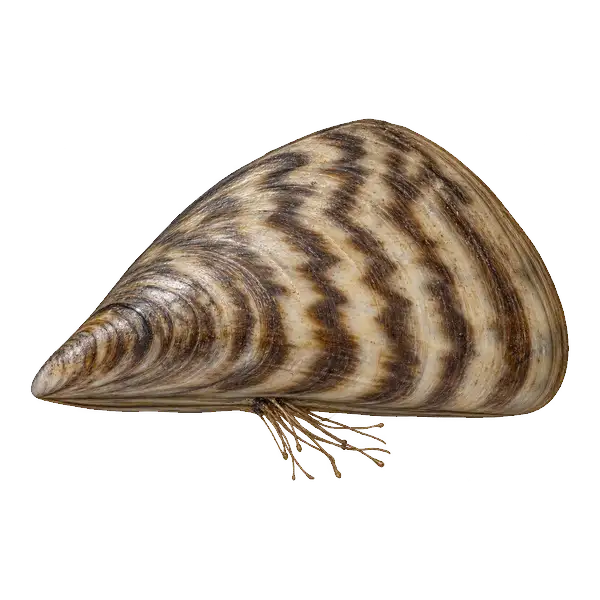
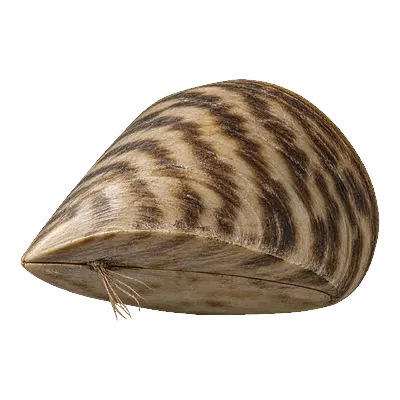
These illustrations are AI-generated, not photographs, and are not to scale. They show what to look for; they are not a substitute for an expert identification.
How to identify it
Size: About 1 inch long, often smaller.
- A D-shaped or triangular shell with a sharp ridge along one edge.
- A flat underside, so the shell sits upright if you set it down.
- Dark and light zigzag or wavy stripes. The pattern varies and can be faint.
- Fine threads that glue it to rocks, docks, boats and other shells, often in clusters.
Don’t confuse it with
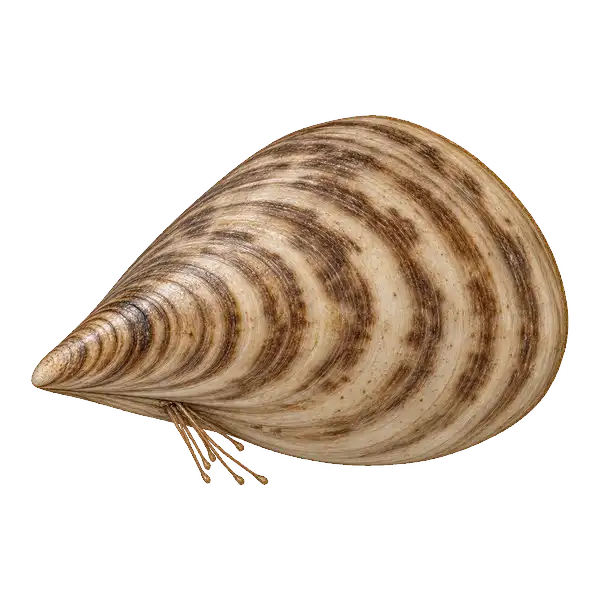
Quagga mussel, another invasive, is rounder and has no flat underside: set one on its side and it rolls over. Native mussels are much larger, have no attachment threads, and live partly buried in the lake bottom.
Where it came from
Native to the Black Sea and Caspian Sea region of eastern Europe and western Asia.
Carried to the Great Lakes in the ballast water of ocean-going ships in the 1980s. It reaches inland lakes mostly on boats, trailers and gear, and as tiny free-floating young in bilge and live-well water.
Earliest dated Michigan record: 1988, Lake Erie at Monroe. This is the oldest dated record in the USGS non-native species database, not necessarily when it first arrived.
Why it matters
Zebra mussels filter large amounts of water, removing the plankton that young fish and many native animals feed on. They coat docks, boat hulls, water intakes and native mussels, and their sharp shells cut bare feet on beaches.
Michigan law
Restricted under Part 413 of Michigan's Natural Resources and Environmental Protection Act. It is illegal to possess, introduce, import, sell or offer to sell it as a live organism, except in the limited cases the law allows. The state uses “restricted” for species already established in Michigan. The state’s page on this species.
If you find it
- Don’t move it. Michigan law requires boaters to remove all aquatic plants from boats, equipment and trailers before launching. Before trailering, you must pull all drain plugs, drain live wells and bilges, and make sure the boat and trailer are free of aquatic plants and animals. What the law requires
- Never release bait. Releasing baitfish into Michigan waters is illegal. Put unused bait in the trash, never in the water.
- Report it. Take a photo, note where you saw it, and report it to the Midwest Invasive Species Information Network (MISIN) or through Michigan’s invasive species program. Experts there can confirm what you found.
- Ask before removing or treating. Treating a lake with herbicides or other chemicals needs a state permit, and some removal work does too. Start with the state’s Aquatic Nuisance Control program before taking action.
Michigan lakes where it has been recorded
206 Michigan lakes on this site have a record of this species.
Alcona
Alger
Allegan
Alpena
Antrim
Barry
Berrien
Branch
Coldwater Lake, Lake of the Woods, Marble Lake, Matteson Lake, Morrison Lake, North Lake, South Lake, Union Lake
Calhoun
Cass
Baldwins Lake, Birch Lake, Christiana Lake, Diamond Lake, Donnell Lake, Eagle Lake, Long Lake, Twin Lakes
Charlevoix
Cheboygan
Black Lake, Burt Lake, Douglas Lake, Long Lake, Mullett Lake
Chippewa
Clare
Arnold Lake, Boyles Creek, Dodge Lake, Eight Point Lake, Five Lakes, Lake George, Silver Lake, Windover Lake
Crawford
Dickinson
Emmet
Genesee
Gladwin
Grand Traverse
Hillsdale
Ingham
Ionia
Iosco
Iron
Jackson
Center Lake, Clark Lake, Farewell Lake, Lime Lake, Pleasant Lake, Vineyard Lake, Wamplers Lake, Wolf Lake
Kalamazoo
Kalkaska
Lapeer
Leelanau
Lenawee
Livingston
East Crooked Lake, Lake Chemung, Ore Lake, Patterson Lake, Sandy Bottom Lake, School Lake, Tamarack Lake, Thompson Lake, Whitewood Lakes, Whitmore Lake, Zukey Lake
Mackinac
Macomb
Manistee
Mason
Missaukee
Montcalm
Montmorency
Muskegon
Newaygo
Oakland
Bald Eagle Lake, Big Lake, Bush Lake, Cass Lake, Cedar Island Lake, Crescent Lake, Elizabeth Lake, Green Lake, Greens Lake, Kent Lake, Lake Oakland, Lake Orion, Lakeville Lake, Loon Lake, Lower Pettibone Lake, Lower Straits Lake, Maceday Lake, Middle Straits Lake, Moore Lake, Orchard Lake, Oxbow Lake, Pine Lake, Pontiac Lake, Proud Lake, Schoolhouse Lake, Silver Lake, Sugden Lake, Tan Lake, Union Lake, Upper Straits Lake, Walled Lake, Watkins Lake, Wolverine Lake, Woodhull Lake
Oceana
Ogemaw
Osceola
Otsego
Ottawa
Presque Isle
Roscommon
Schoolcraft
St. Joseph
Van Buren
Bankson Lake, Cedar Lake, Gravel Lake, Great Bear Lake, Lake of the Woods, Saddle Lake
Washtenaw
Barton Pond, Blind Lake, Bruin Lake, Ford Lake, Halfmoon Lake, Independence Lake
Wayne
Wexford
A lake that is not listed may still have it. Records exist only where someone found the species and reported it, so “not recorded” does not mean “not present.”
Lake records: Midwest Glacial Lakes Partnership Conservation Planner; underlying records from the USGS Nonindigenous Aquatic Species database.
Sources
- Michigan Invasive Species Program: Zebra mussel
- USGS Nonindigenous Aquatic Species: Zebra mussel fact sheet
- Michigan Compiled Laws, section 324.41302 (prohibited and restricted species)
Earliest dated record: USGS Nonindigenous Aquatic Species database.