Shoreline and wetland plant
Purple Loosestrife
Lythrum salicaria
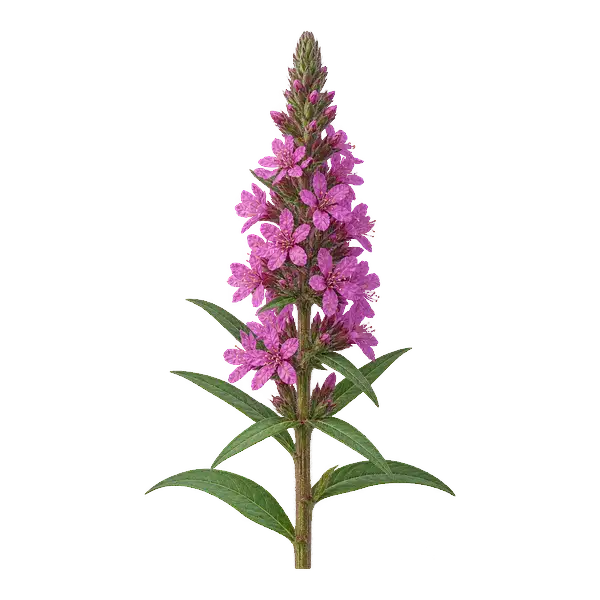

These illustrations are AI-generated, not photographs, and are not to scale. They show what to look for; they are not a substitute for an expert identification.
How to identify it
Size: Often 4 to 10 feet tall.
- Tall spikes of magenta-purple flowers in mid to late summer.
- Each flower has 5 to 7 crinkled petals.
- Lance-shaped leaves with smooth edges, attached straight to the stem in pairs or rings of three.
- A stiff, angled stem, often with four to six sides.
Don’t confuse it with
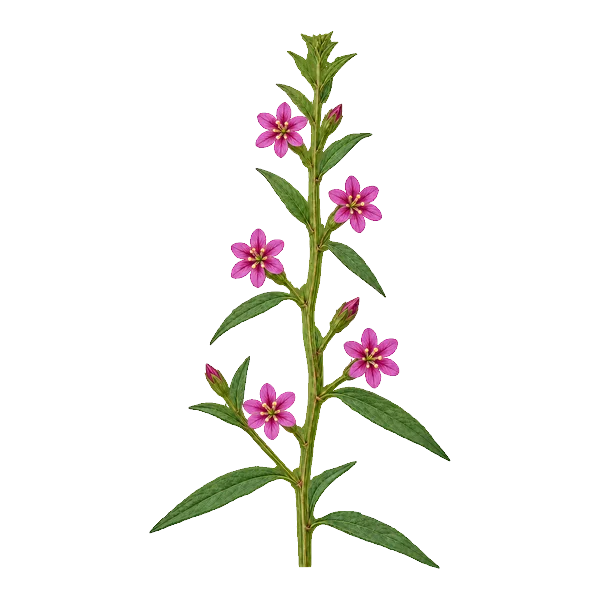
Fireweed has four petals and leaves that alternate along a round stem. Native winged loosestrife is smaller, with single flowers where the leaves meet the stem rather than a dense spike.
This is a shoreline and wetland plant. You will find it along the water's edge, not out in the lake.

Where it came from
Native to Europe and Asia.
Arrived in eastern North America in the early 1800s, probably in ships' ballast and as a garden and medicinal plant. It spreads through huge numbers of tiny seeds carried by water, wind, animals and people.
Earliest dated Michigan record: 1879, the Lake Michigan shoreline at Muskegon. This is the oldest dated record in the USGS non-native species database, not necessarily when it first arrived.
Why it matters
It forms dense stands along shores and in wetlands that push out the native plants birds, insects and other wildlife depend on.
Michigan law
Restricted under Part 413 of Michigan's Natural Resources and Environmental Protection Act. It is illegal to possess, introduce, import, sell or offer to sell it as a live organism, except in the limited cases the law allows. The state uses “restricted” for species already established in Michigan. The state’s page on this species.
If you find it
- Don’t move it. Michigan law requires boaters to remove all aquatic plants from boats, equipment and trailers before launching. Before trailering, you must pull all drain plugs, drain live wells and bilges, and make sure the boat and trailer are free of aquatic plants and animals. What the law requires
- Never release bait. Releasing baitfish into Michigan waters is illegal. Put unused bait in the trash, never in the water.
- Report it. Take a photo, note where you saw it, and report it to the Midwest Invasive Species Information Network (MISIN) or through Michigan’s invasive species program. Experts there can confirm what you found.
- Ask before removing or treating. Treating a lake with herbicides or other chemicals needs a state permit, and some removal work does too. Start with the state’s Aquatic Nuisance Control program before taking action.
Michigan lakes where it has been recorded
104 Michigan lakes on this site have a record of this species.
Alcona
Alger
Allegan
Alpena
Antrim
Barry
Berrien
Branch
Calhoun
Charlevoix
Cheboygan
Clare
Clinton
Crawford
Dickinson
Genesee
Gogebic
Grand Traverse
Hillsdale
Ingham
Ionia
Iron
Jackson
Center Lake, Farewell Lake, Grass Lake, Vineyard Lake, Wamplers Lake
Kalamazoo
Kalkaska
Keweenaw
Lapeer
Leelanau
Lenawee
Livingston
Lake Chemung, Thompson Lake, Whitewood Lakes, Whitmore Lake, Woodland Lake, Zukey Lake
Marquette
Mecosta
Montmorency
Muskegon
Newaygo
Oakland
Kent Lake, Lake Orion, Long Lake, Orchard Lake, Pontiac Lake, Proud Lake, Tan Lake, Union Lake, White Lake, Wolverine Lake
Ogemaw
Ontonagon
Roscommon
Schoolcraft
Washtenaw
Wayne
Wexford
A lake that is not listed may still have it. Records exist only where someone found the species and reported it, so “not recorded” does not mean “not present.”
Lake records: Midwest Glacial Lakes Partnership Conservation Planner; underlying records from the USGS Nonindigenous Aquatic Species database.
Sources
- Michigan Invasive Species Program: Purple loosestrife
- USGS Nonindigenous Aquatic Species: Purple loosestrife fact sheet
- Michigan Compiled Laws, section 324.41302 (prohibited and restricted species)
Earliest dated record: USGS Nonindigenous Aquatic Species database.