Smith Moore
Circa-1880 steam-and-sail ore freighter before the 1888 reinforcement
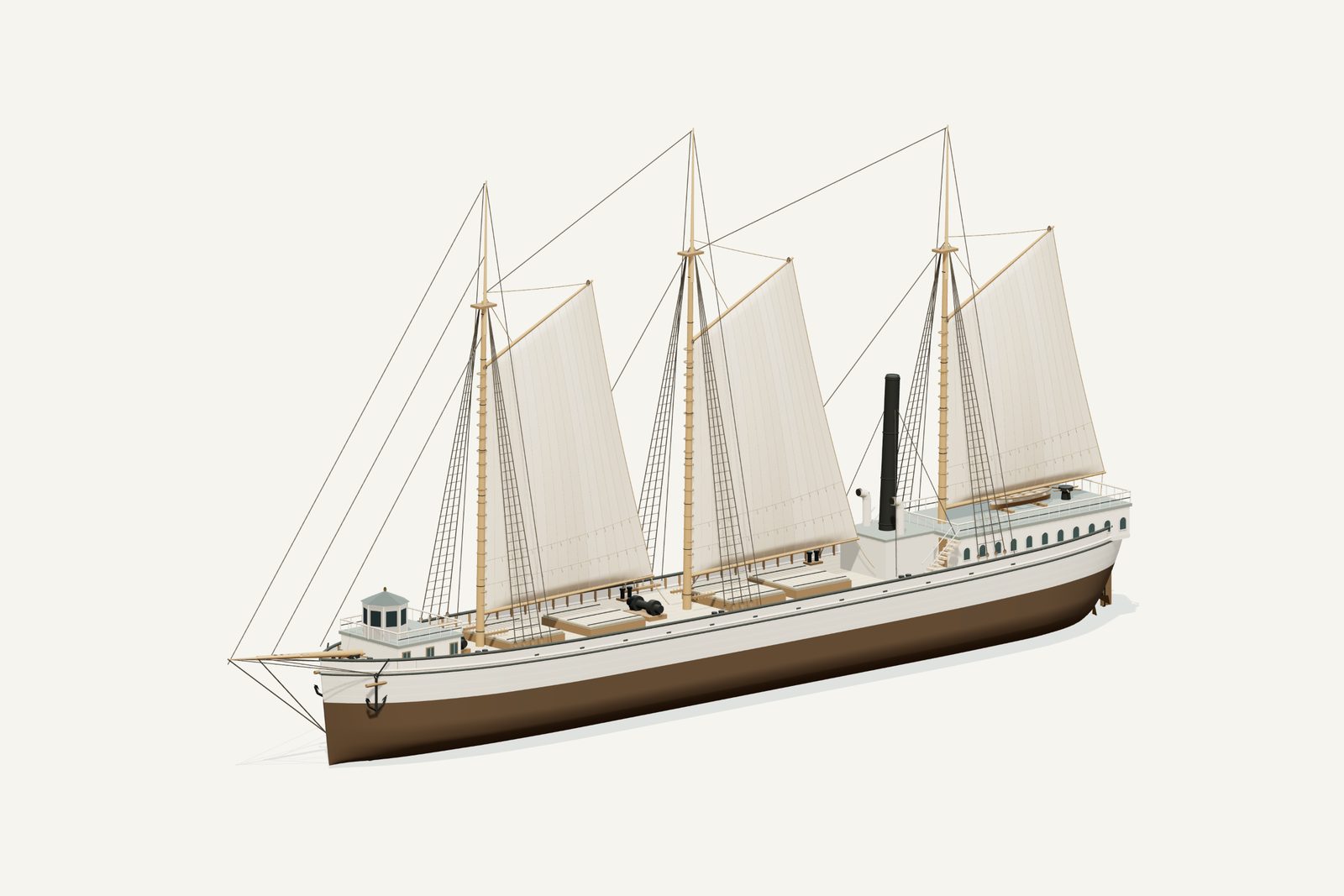
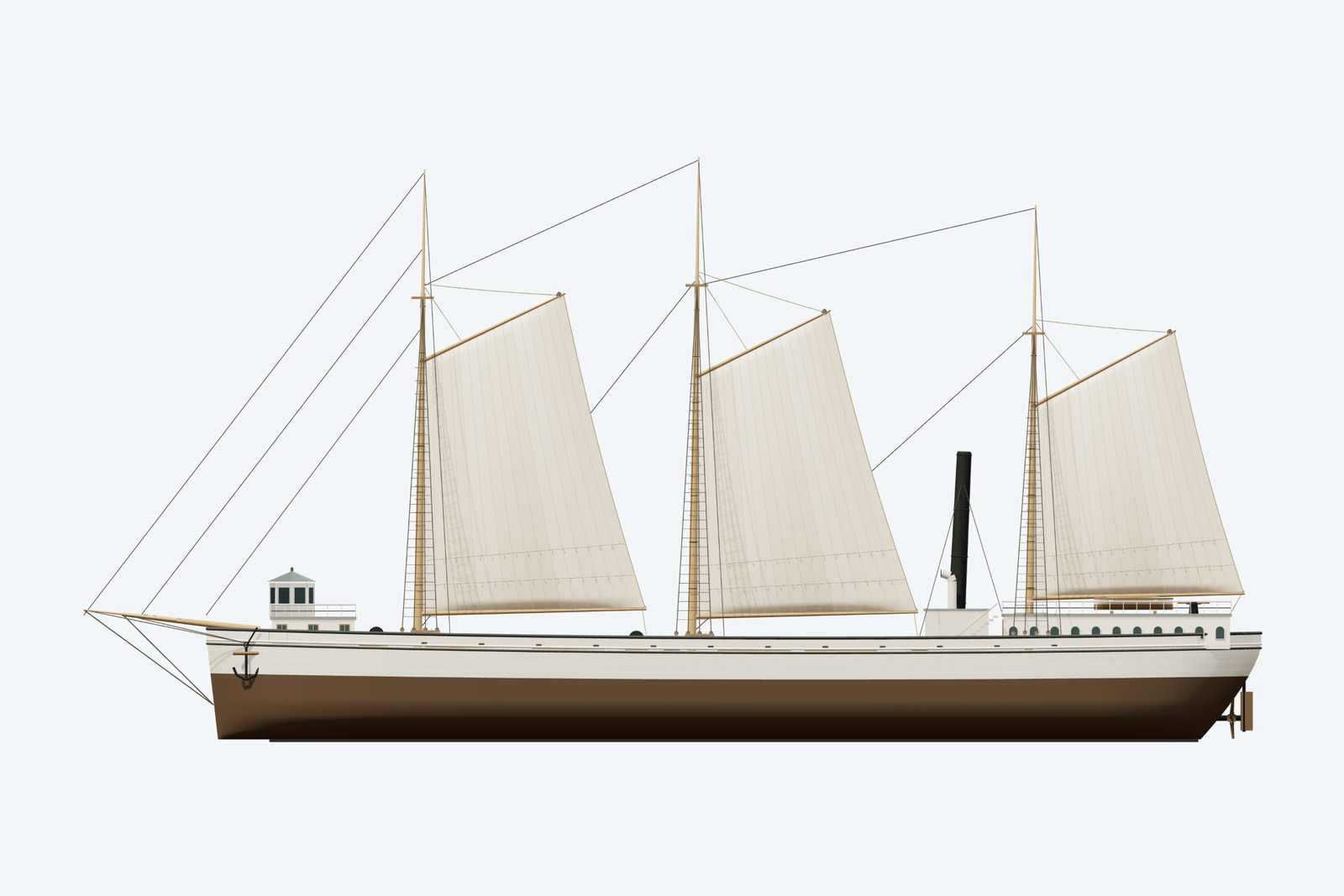
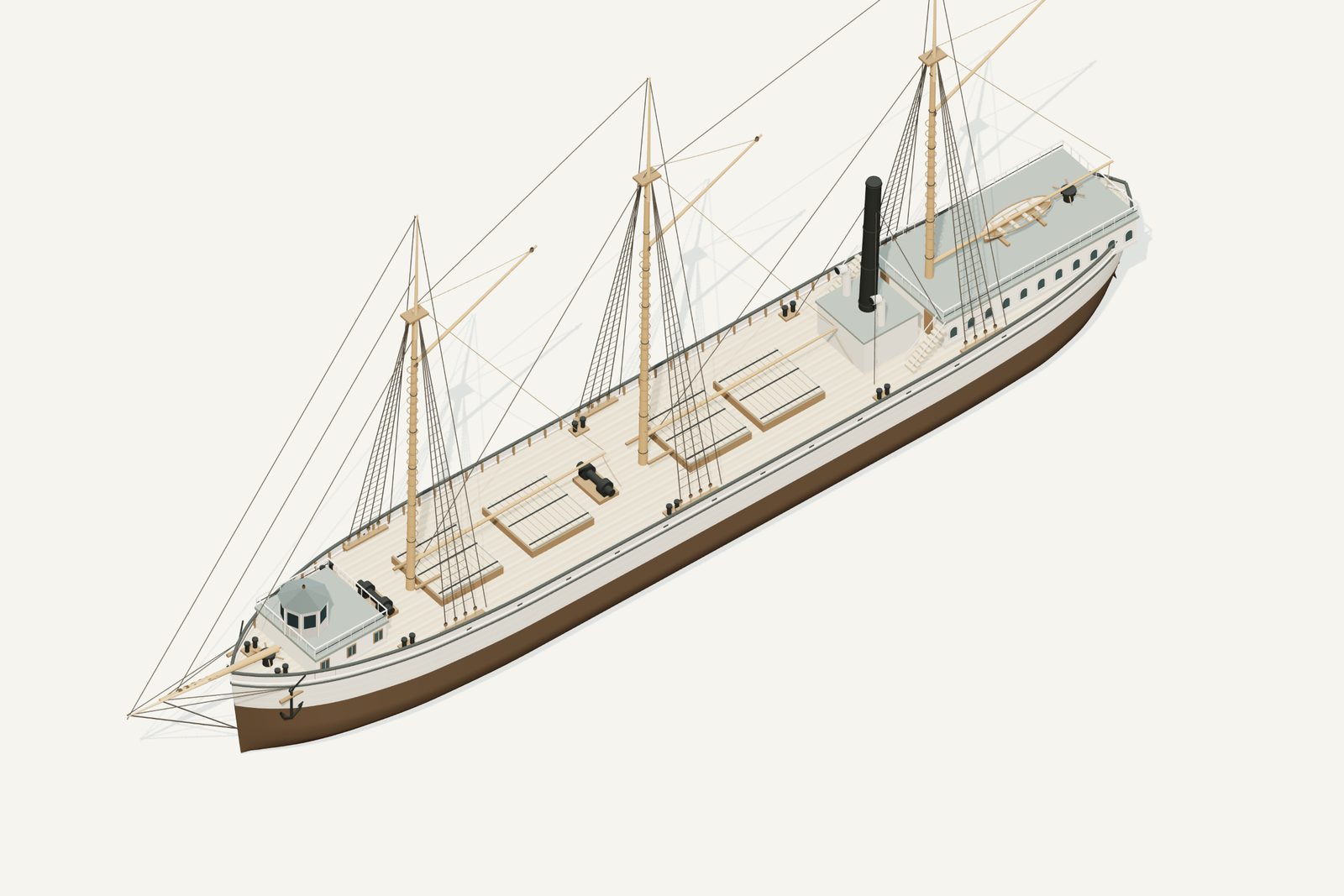
An interpretive 3D reconstruction of the vessel afloat, in the form named above and from before its loss in Munising Bay. It is informed by the historical record set out under History below, where the documented evidence and the interpretation are kept apart; rigging, colours and fittings are partly inferred. It is not a survey of the wreck.
Divers have confirmed exactly where this wreck lies.
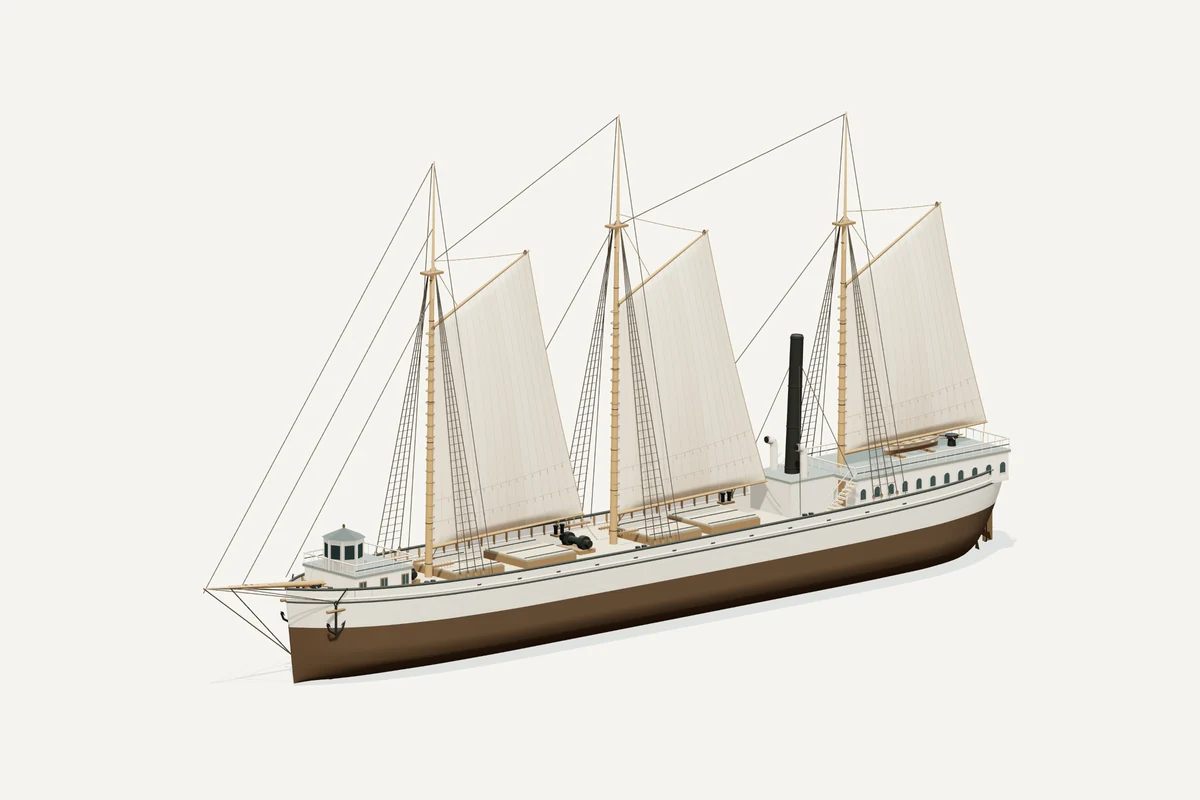
Starboard bow · complete vessel · drag to rotate, scroll or pinch to zoom, right-drag to pan. Hiding the sails shows the deck; it does not recreate the wreck.
What the model represents
From the model specification. Two lists, kept apart on purpose.
Documented
- The dimensional baseline is 223.4 × 35 × 18.2 ft. ECU Research Report 13, Table 1.
- Smith Moore was launched July 12, 1880 at Cleveland by George Presley & Son. The NPS comparison records two decks, three masts, one funnel and an original 130 ft arch below decks; two steel arches were added in 1888. No claim that the arches were external is made. Marquette nomination, Section 8.
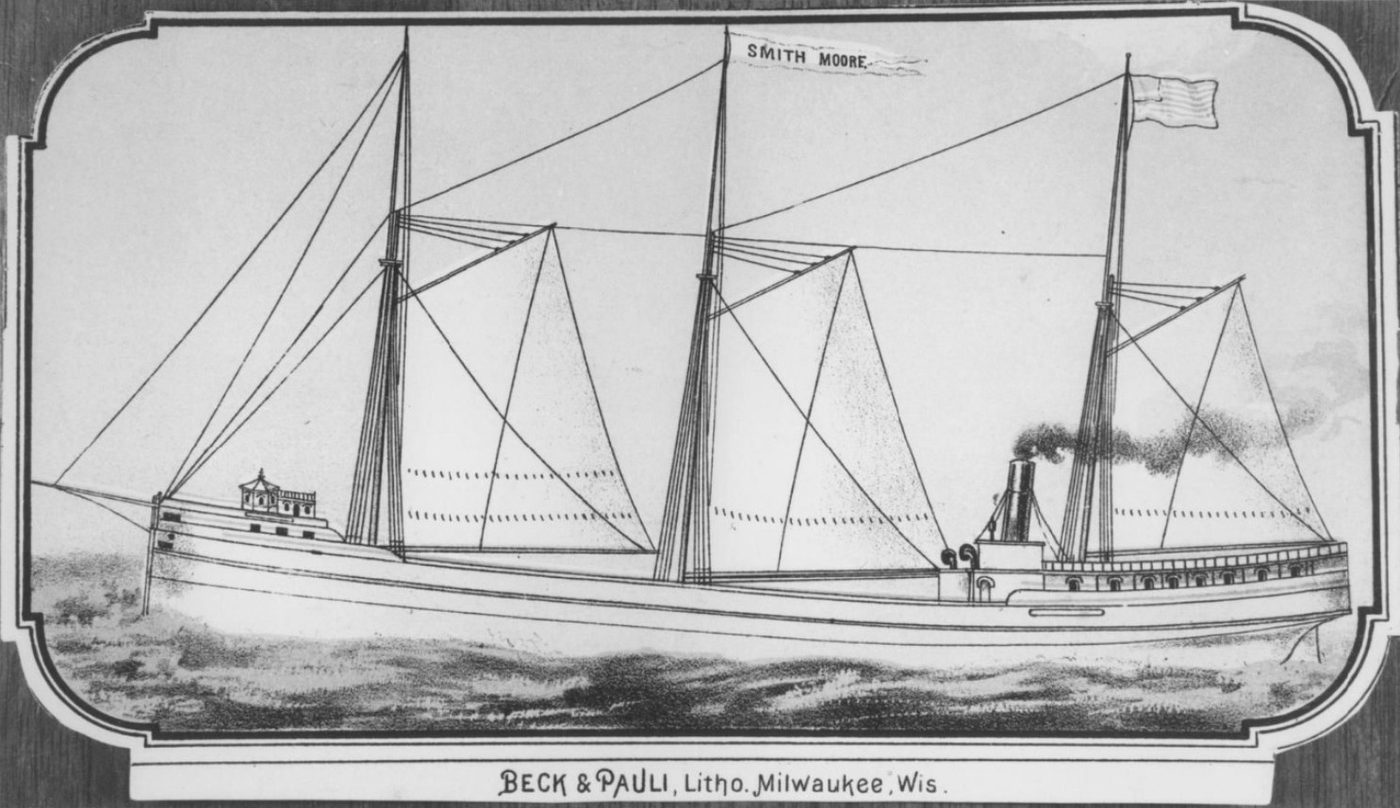
- The Beck & Pauli lithograph shows three gaff sails, a short bowsprit, small forward pilothouse, aft funnel with two adjacent cowl ventilators and arched aft-house windows. Alpena record 2903806, Commons lithograph.
- The inventory lists US 115721 and 1, 191 gross tons. Smith Moore sank July 13, 1889 after collision with James Pickands in the East Channel; M.M. Drake took off the crew and the ship sank under tow. 3 DShipwrecks.

Inferred
- Mast heights, hatch count and spacing, underwater lines, propeller, boat detail, hardware and paint pigments are interpreted.
- Two existing cowl ventilators were repositioned closer to the funnel; a duplicate pair was not added. Window arches follow the print, while window sizes and unseen faces remain estimates.
Configuration caveat. Circa 1880 exterior follows the Beck & Pauli lithograph. An original below-deck arch is documented; two later steel arches were added in 1888. The selected 223.4 ft register length conflicts with 260 ft tour accounts. Hidden hull, hatch layout, pigments and small fittings remain interpreted.
Deliberately not modelled
- 1888 external steel strengthening arches: model represents original configuration
- Interior steam engine and cargo holds
- Wreck survey or photogrammetry geometry
- Modern fittings
Two numbers that are not the same thing. The waterline toggle sits at 4.25 m above the keel, a display assumption, not a measured draft. The wreck lies in about 105 ft of water; that describes the site, not the ship.
Renders from the model
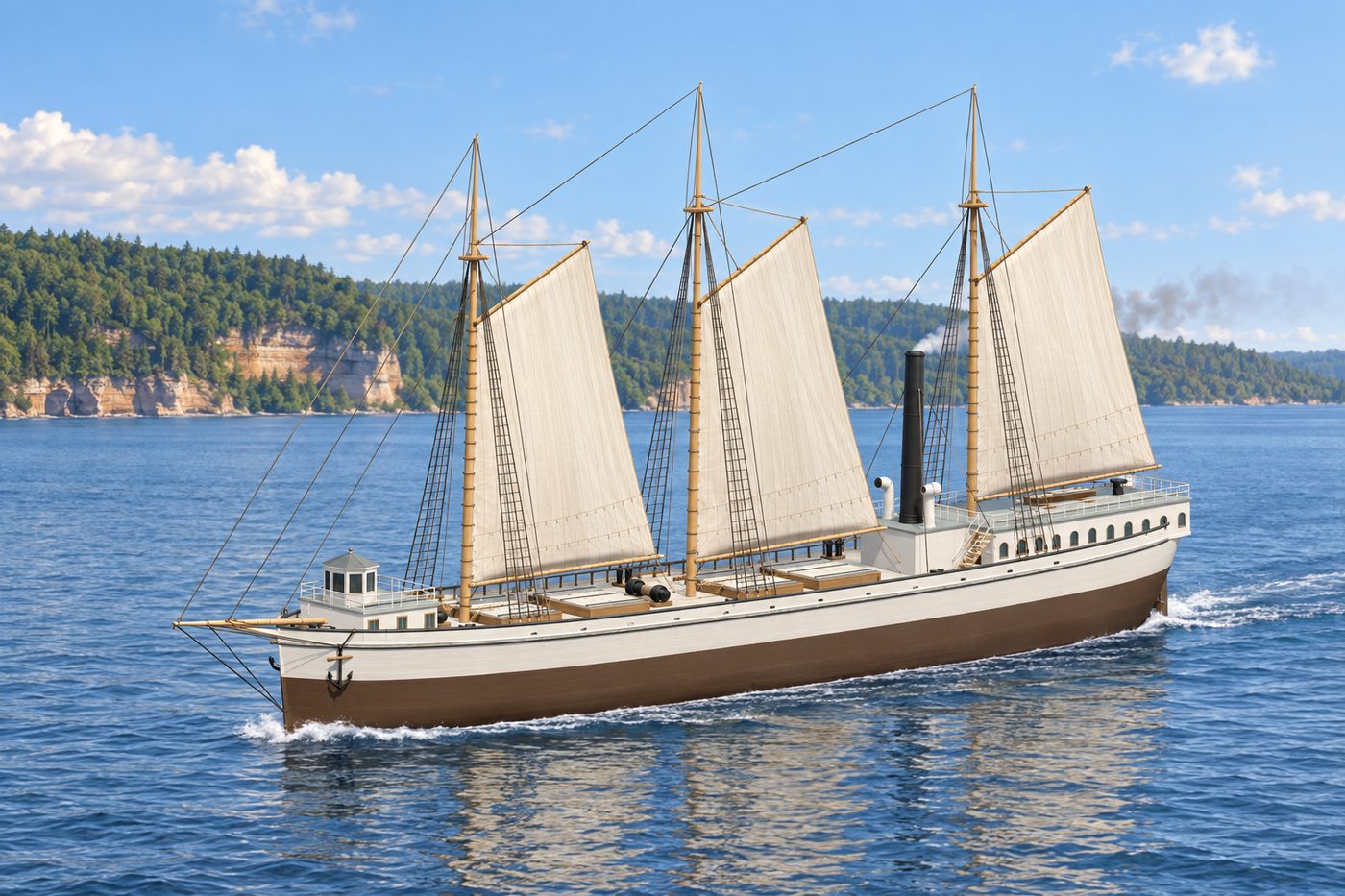
History, evidence and limits
The research notes behind the reconstruction, reproduced with their citations.
Version 1.1. Revised September 8, 2026.
Selected appearance
Circa-1880 steam-and-sail ore freighter before the 1888 reinforcement. The original below-deck arch is part of the documented structure, although concealed structure is outside this exterior model.
Documented evidence
The dimensional baseline is 223.4 × 35 × 18.2 ft. ECU Research Report 13, Table 1.
Smith Moore was launched July 12, 1880 at Cleveland by George Presley & Son. The NPS comparison records two decks, three masts, one funnel and an original 130 ft arch below decks; two steel arches were added in 1888. No claim that the arches were external is made. Marquette nomination, Section 8.
The Beck & Pauli lithograph shows three gaff sails, a short bowsprit, small forward pilothouse, aft funnel with two adjacent cowl ventilators and arched aft-house windows. Alpena record 2903806, Commons lithograph.
The inventory lists US 115721 and 1, 191 gross tons. Smith Moore sank July 13, 1889 after collision with James Pickands in the East Channel; M.M. Drake took off the crew and the ship sank under tow. 3 DShipwrecks.
Reasonable interpretation
Mast heights, hatch count and spacing, underwater lines, propeller, boat detail, hardware and paint pigments are interpreted.
Two existing cowl ventilators were repositioned closer to the funnel; a duplicate pair was not added. Window arches follow the print, while window sizes and unseen faces remain estimates.
Unresolved uncertainties
The selected 223.4 ft registered length conflicts with the often-repeated 260 ft dive-tour figure; no documented measurement basis was recovered to reconcile them.
The monochrome lithograph is an artist’s depiction, not a measured plan. Its sky-banner name is not evidence for lettering on the bow.
The later 1888 arches are omitted from this earlier exterior configuration; omission does not mean the original vessel lacked its below-deck arch.
Sources
- ECU comparative report, Table 1
- NPS Marquette nomination, Section 8
- Beck & Pauli lithograph, Alpena County Library
- Lithograph public-domain description
- Wreck inventory
Illustration conditions
Supplemental AI artwork is made from the revised model render where the model changed; the provenance records the actual input files. Lake, shore, sky and weather are artistic staging, not evidence of a final voyage or a measured location. The actual GLB and its direct renders are the geometry reference.
Sources used for the model
Rights and respect
Removing or disturbing wreckage on Great Lakes bottomlands is a felony under Michigan Part 761, 1994 PA 451, at a fair market value of $100 or more. Positions are historical reference only — not navigation and not dive-planning data. Wreck records are published by the Michigan Underwater Preserve Council.
Treat these as graves. Lives were lost on many Great Lakes wrecks and human remains may still be present. Look, photograph, and leave everything exactly as you found it.
Model and renders were newly made for this project (2026). Three.js r160.1 is used under the MIT licence; its notice ships with the vendored files. Wreck position, depth and dates: Michigan Underwater Preserve Council. The model specification (version 1.1, revised 2026-09-08) is published beside the assets (model-spec.json).