Goshawk
Photographed two-mast schooner-barge form after the 1904 Bay City rebuild
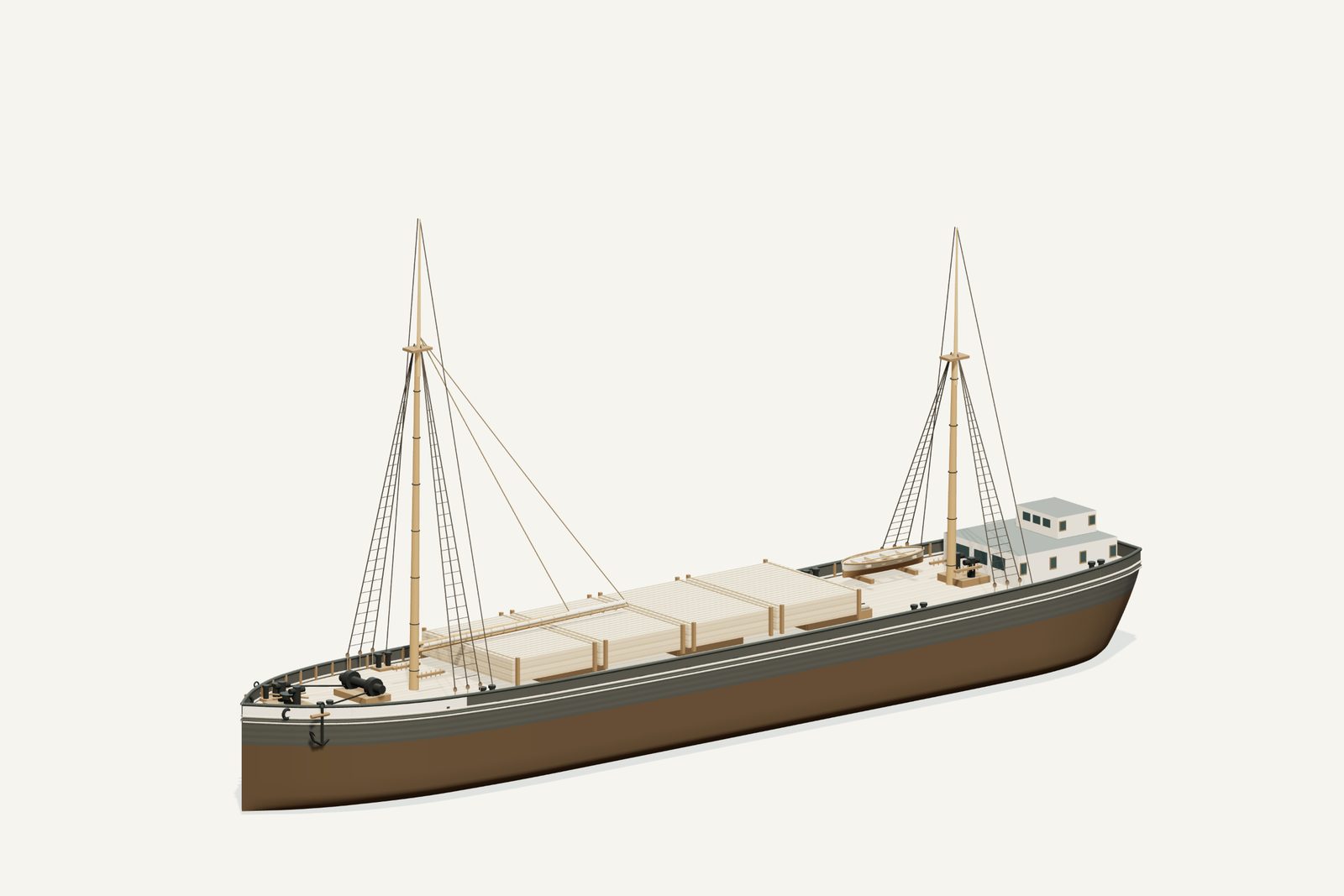
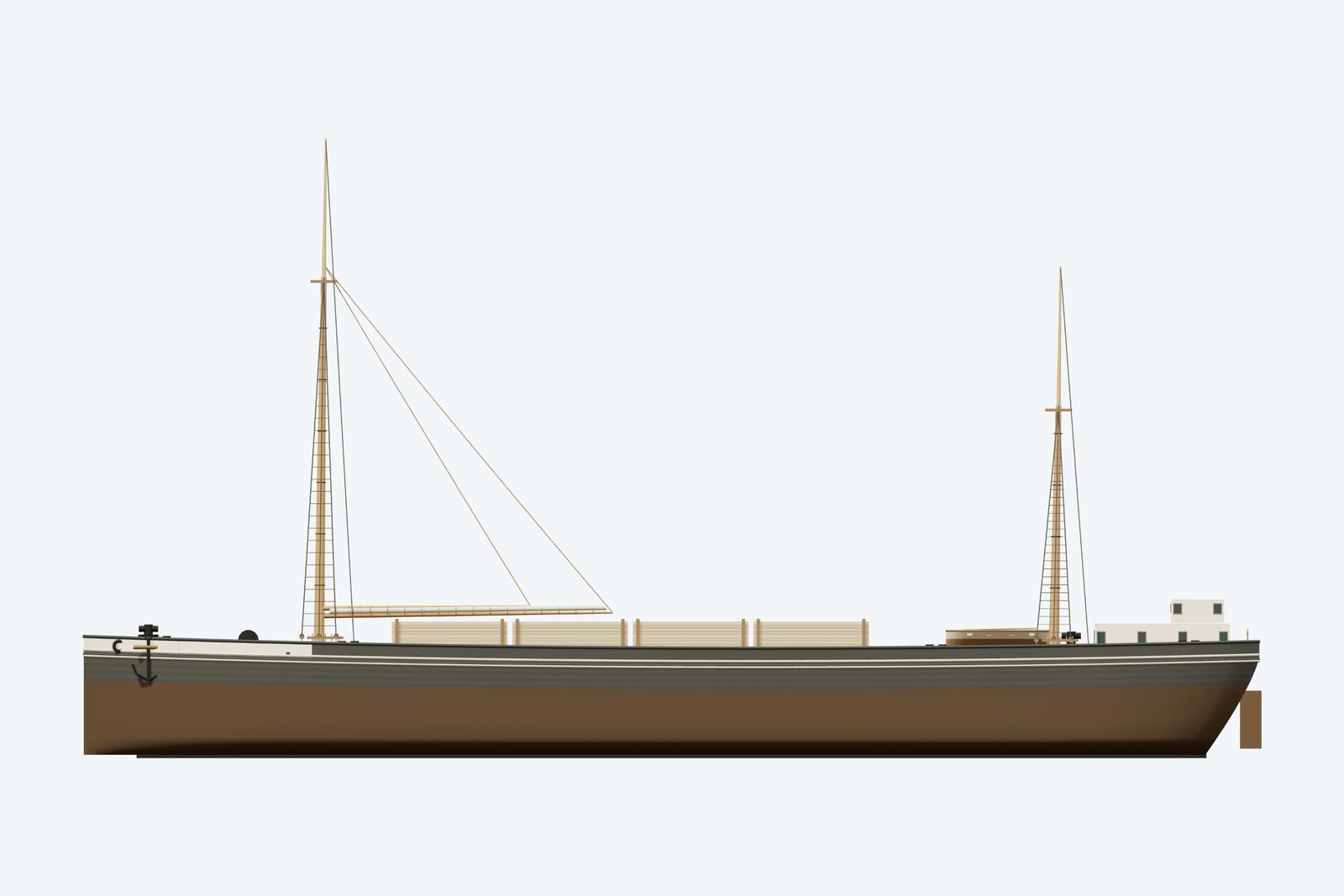
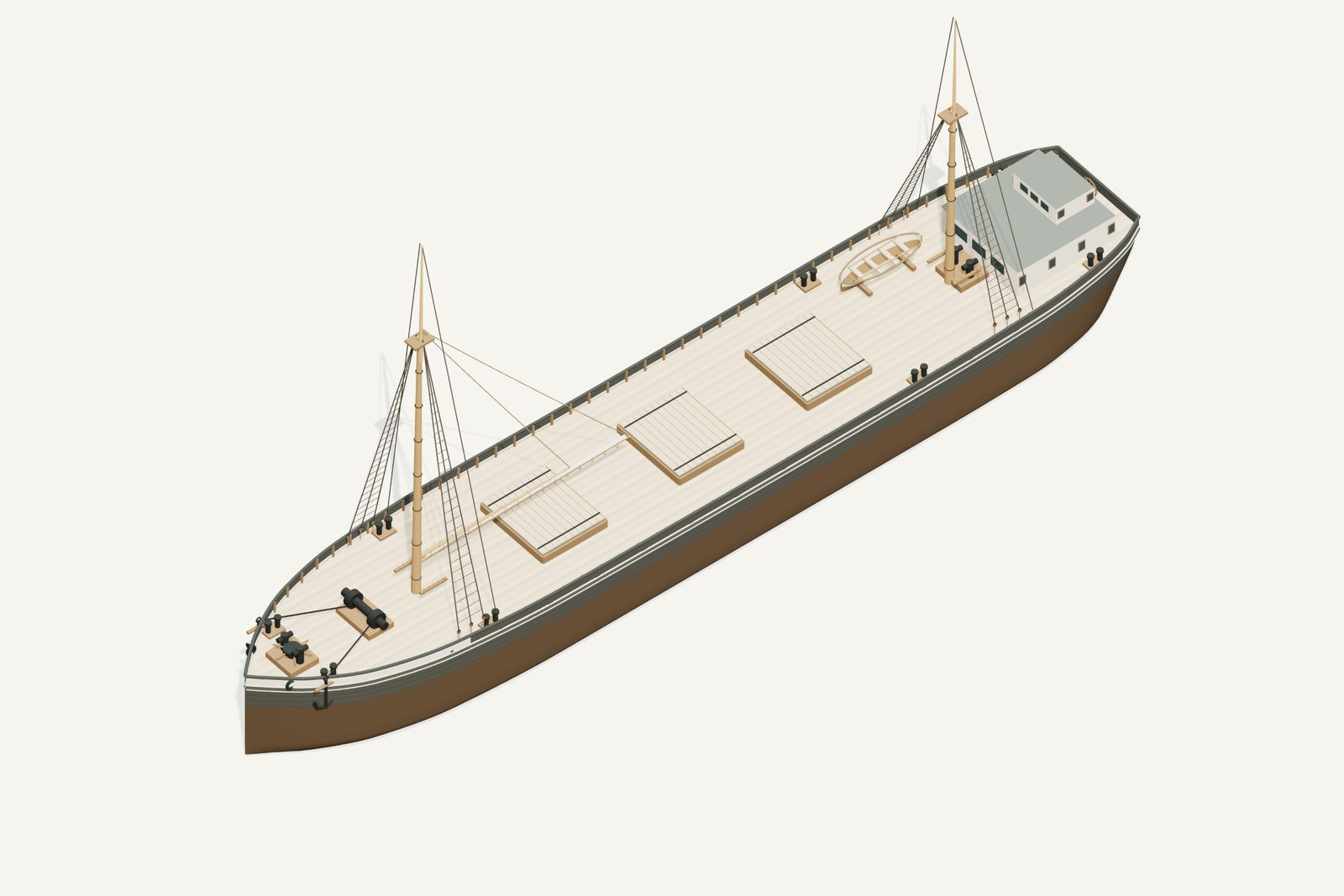
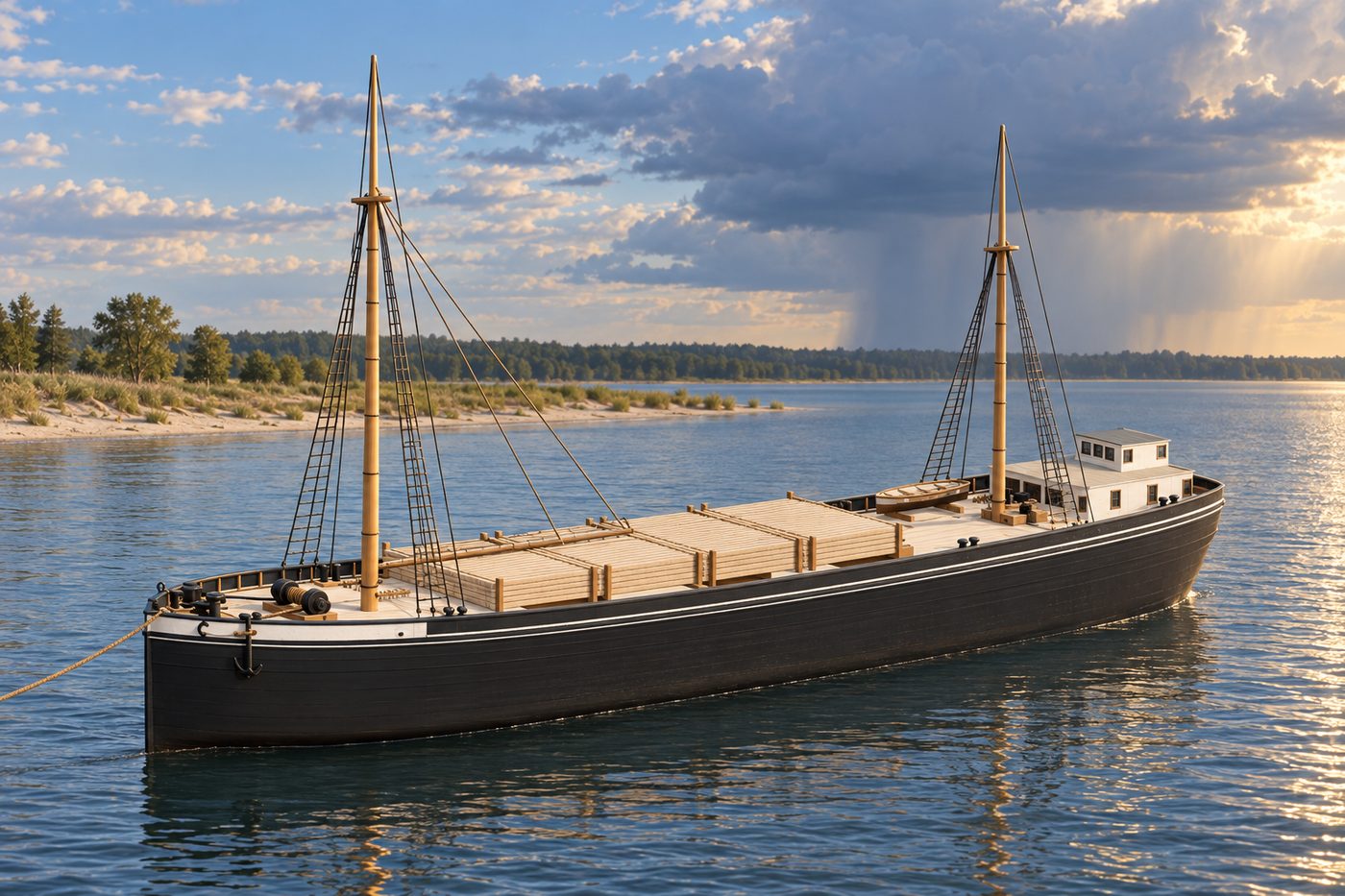
An interpretive 3D reconstruction of the vessel afloat, in the form named above and from before its loss in Tawas Bay. It is informed by the historical record set out under History below, where the documented evidence and the interpretation are kept apart; rigging, colours and fittings are partly inferred. It is not a survey of the wreck.
Nobody knows the exact spot where this ship went down, so the marker shows the general area.
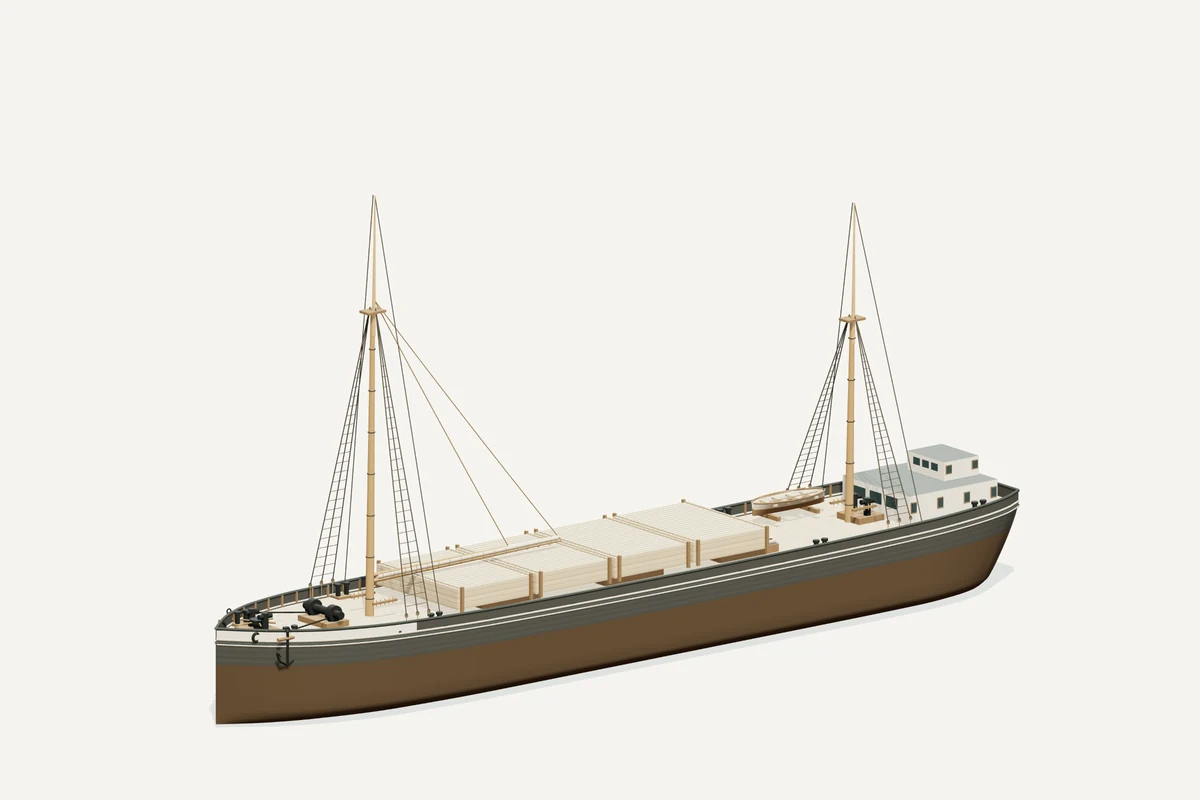
Starboard bow · complete vessel · drag to rotate, scroll or pinch to zoom, right-drag to pan. Hiding a part shows what sat beneath it; it does not recreate the wreck.
What the model represents
From the model specification. Two lists, kept apart on purpose.
Documented
- Alpena’s vessel record gives construction by I. Lafrinier at Cleveland in 1866 as a wooden three-masted schooner and a 1904 rebuild at Bay City as a two-masted barge, then 180 × 32.4 × 11.5 ft. Alpena vessel chronology.
- The Louis Pesha photograph shows two unequal masts, a low aft cabin with a small raised steering shelter, a pale bow bulwark, dark hull with a narrow light stripe and a large deck load of lumber. These are observations of the photographed career form. Pesha photograph, Edward J. Dowling Collection, University of Detroit-Mercy, via Alpena.
- Goshawk foundered off Tawas on June 16, 1920 without loss of life. Swayze calls the vessel 54 years old and gives lumber as cargo. Swayze, G.
Inferred
- Mast heights and stations, towing bitts, hawse fittings, hidden deck gear and cargo quantity are estimated from the own-vessel photograph.
- The earlier Lizzie A. Law comparison remains relevant to cut-down towbarge practice, but it is not direct Goshawk evidence.
- Paint pigments, underwater lines and working draft remain interpreted.
Configuration caveat. Built in 1866; shown after the documented 1904 conversion from three masts to a two-mast barge. Own photographs guide the unequal masts, dark hull, pale bow works and aft steering shelter. Exact gear and hull lines are inferred; lumber versus salt at loss remains unresolved.
Two numbers that are not the same thing. The waterline toggle sits at 3.20 m above the keel, a display assumption, not a measured draft. The wreck lies in about 40 ft of water; that describes the site, not the ship.
Renders from the model
History, evidence and limits
The research notes behind the reconstruction, reproduced with their citations.
Version 1.1. Revised September 8, 2026.
Selected appearance
Photographed two-mast schooner-barge form after the 1904 Bay City rebuild. Construction in 1866 is confirmed; 1886 in the old catalogue was an error. The Louis Pesha photograph now provides evidence of Goshawk’s own upper works.
Documented evidence
Alpena’s vessel record gives construction by I. Lafrinier at Cleveland in 1866 as a wooden three-masted schooner and a 1904 rebuild at Bay City as a two-masted barge, then 180 × 32.4 × 11.5 ft. Alpena vessel chronology.
The Louis Pesha photograph shows two unequal masts, a low aft cabin with a small raised steering shelter, a pale bow bulwark, dark hull with a narrow light stripe and a large deck load of lumber. These are observations of the photographed career form. Pesha photograph, Edward J. Dowling Collection, University of Detroit-Mercy, via Alpena.
Goshawk foundered off Tawas on June 16, 1920 without loss of life. Swayze calls the vessel 54 years old and gives lumber as cargo. Swayze, G.
Reasonable interpretation
Mast heights and stations, towing bitts, hawse fittings, hidden deck gear and cargo quantity are estimated from the own-vessel photograph.
The earlier Lizzie A. Law comparison remains relevant to cut-down towbarge practice, but it is not direct Goshawk evidence.
Paint pigments, underwater lines and working draft remain interpreted.
Unresolved uncertainties
Original dimensions differ by record: HCGL 180 × 32.25 × 12.66 ft; Alpena’s original entry 180 × 32.3 × 12.8 ft. The geometry selects Alpena’s explicit 1904 measurements for the photographed two-mast form.
Cargo at loss conflicts: lumber in Swayze and preserve accounts, salt in tow in the HCGL enrollment abstract cited by the audit. The pictured deck lumber illustrates a photographed working cargo, not proof of the last cargo.
Depth reports span 40 ft in the catalogue, 45 ft in Alpena and 50 ft in the UASC Wreck Checker. UASC’s underwater-lumberyard wording describes wreckage; the 54-year statement belongs to Swayze.
Sources
- Alpena vessel chronology
- Louis Pesha photograph
- Jack Messmer bow-view photograph
- HCGL enrollment abstract, item 435544
- Swayze G
- Lizzie A. Law comparative history
- UASC Wreck Checker, winter2005
Illustration conditions
Supplemental AI artwork is made from the revised model render where the model changed; the provenance records the actual input files. Lake, shore, sky and weather are artistic staging, not evidence of a final voyage or a measured location. The actual GLB and its direct renders are the geometry reference.
Sources used for the model
Rights and respect
Removing or disturbing wreckage on Great Lakes bottomlands is a felony under Michigan Part 761, 1994 PA 451, at a fair market value of $100 or more. Positions are historical reference only — not navigation and not dive-planning data. Wreck records are published by the Michigan Underwater Preserve Council.
Treat these as graves. Lives were lost on many Great Lakes wrecks and human remains may still be present. Look, photograph, and leave everything exactly as you found it.
Model and renders were newly made for this project (2026). Three.js r160.1 is used under the MIT licence; its notice ships with the vendored files. Wreck position, depth and dates: Michigan Underwater Preserve Council. The model specification (version 1.1, revised 2026-09-08) is published beside the assets (model-spec.json).