William P. Rend
Photographed William P. Rend career form
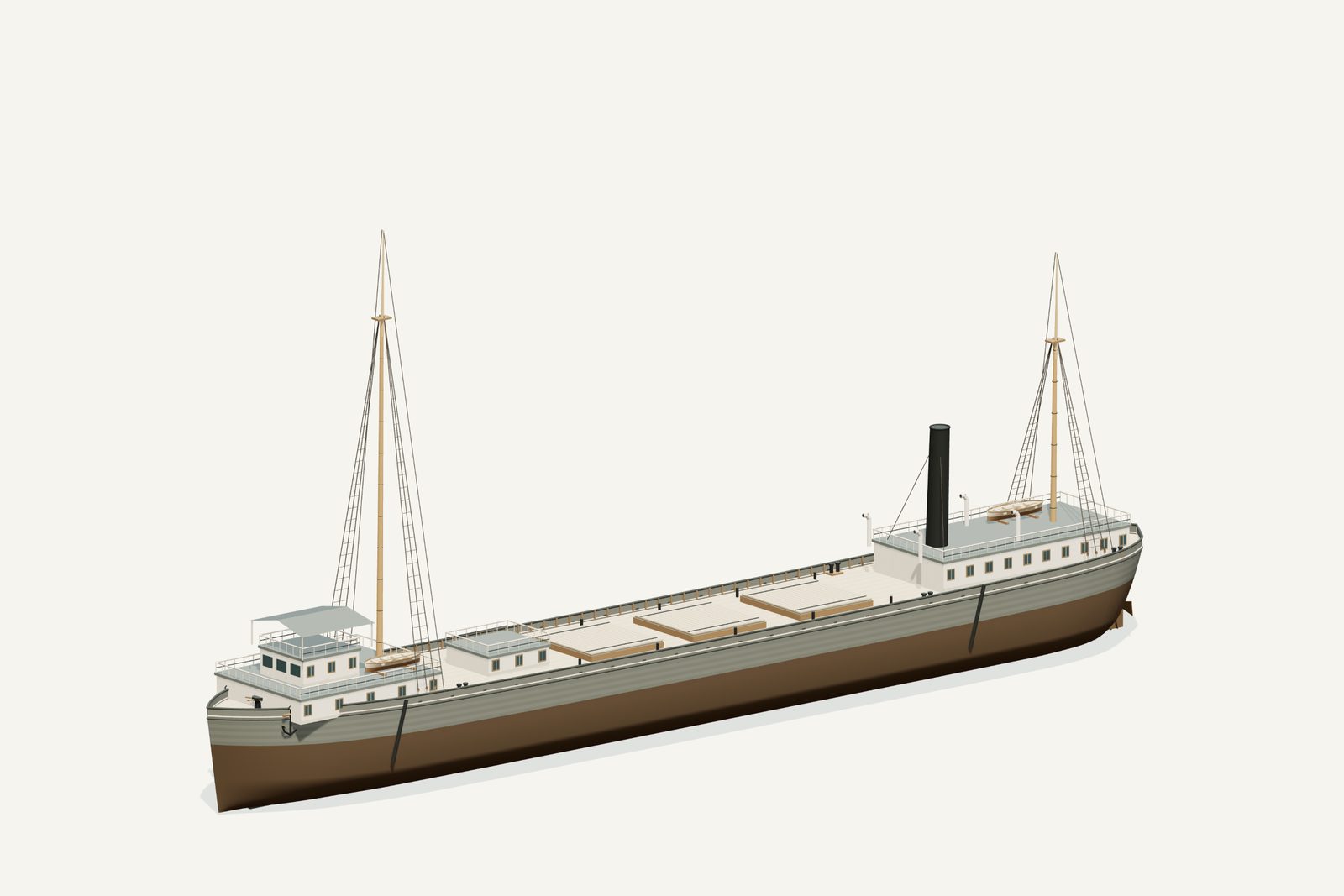
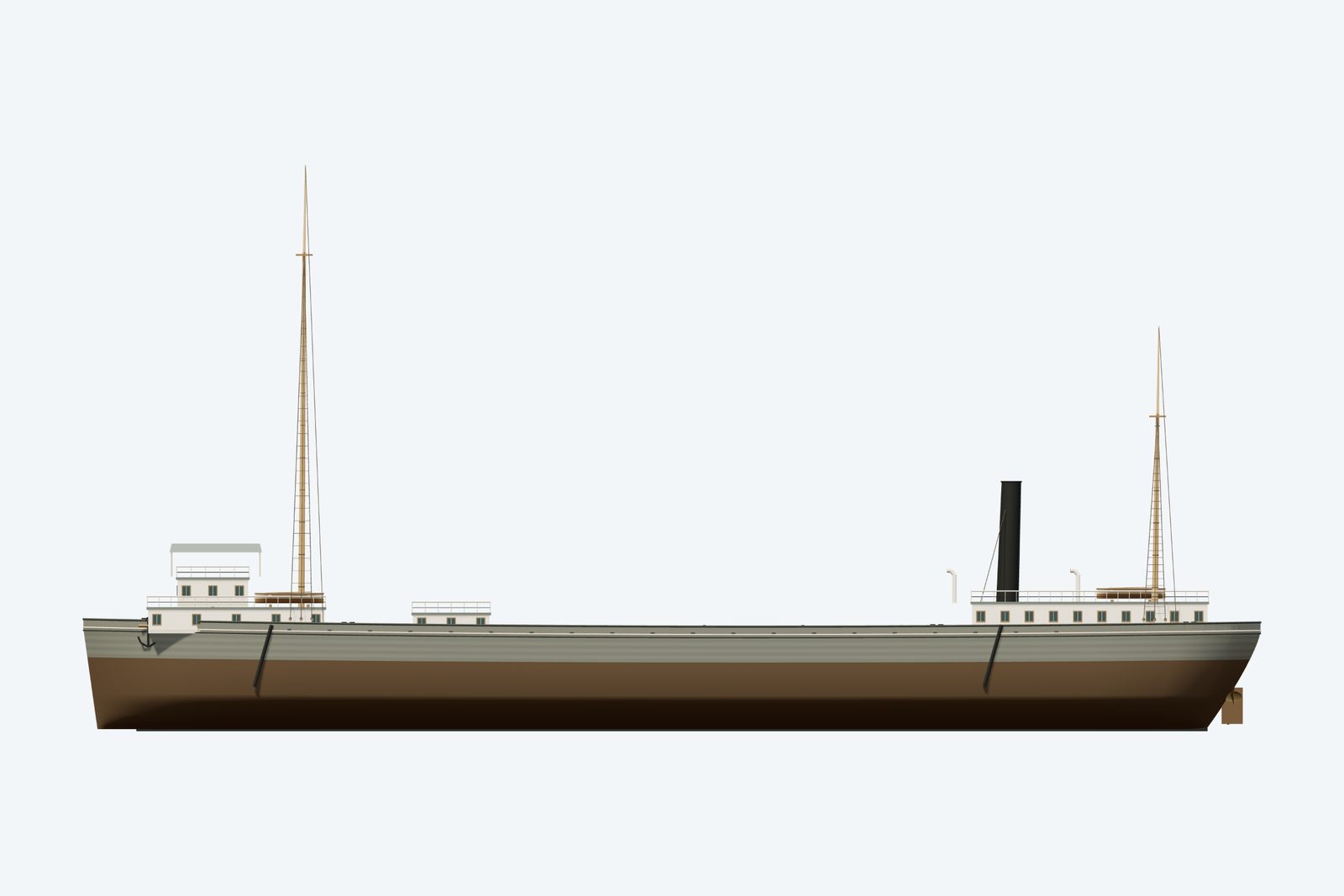
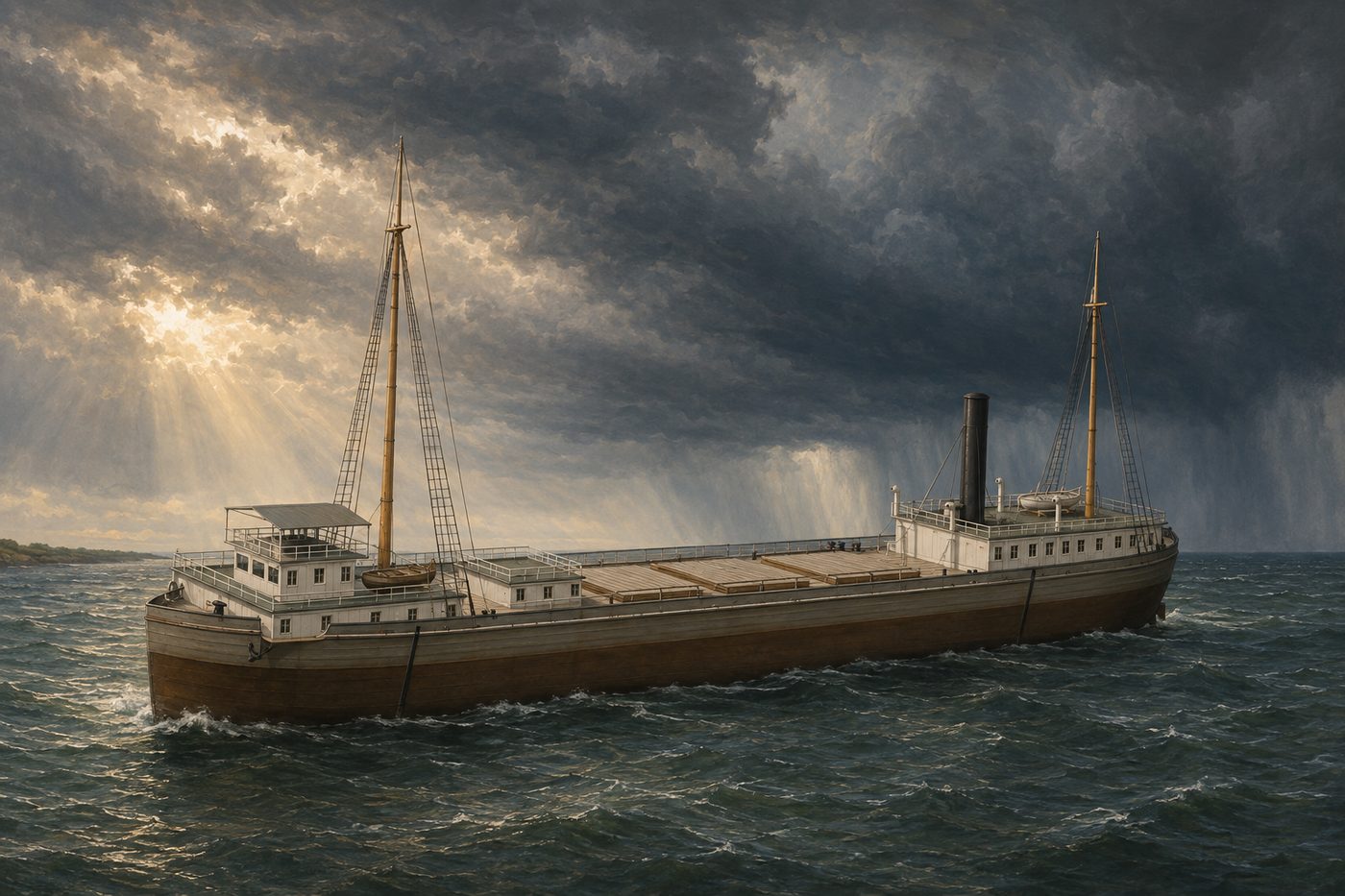
An interpretive 3D reconstruction of the vessel afloat, in the form named above and from before its loss in Thunder Bay. It is informed by the historical record set out under History below, where the documented evidence and the interpretation are kept apart; rigging, colours and fittings are partly inferred. It is not a survey of the wreck.
This ship ran aground along this shore. Nobody knows the exact spot, so the marker shows the general area.
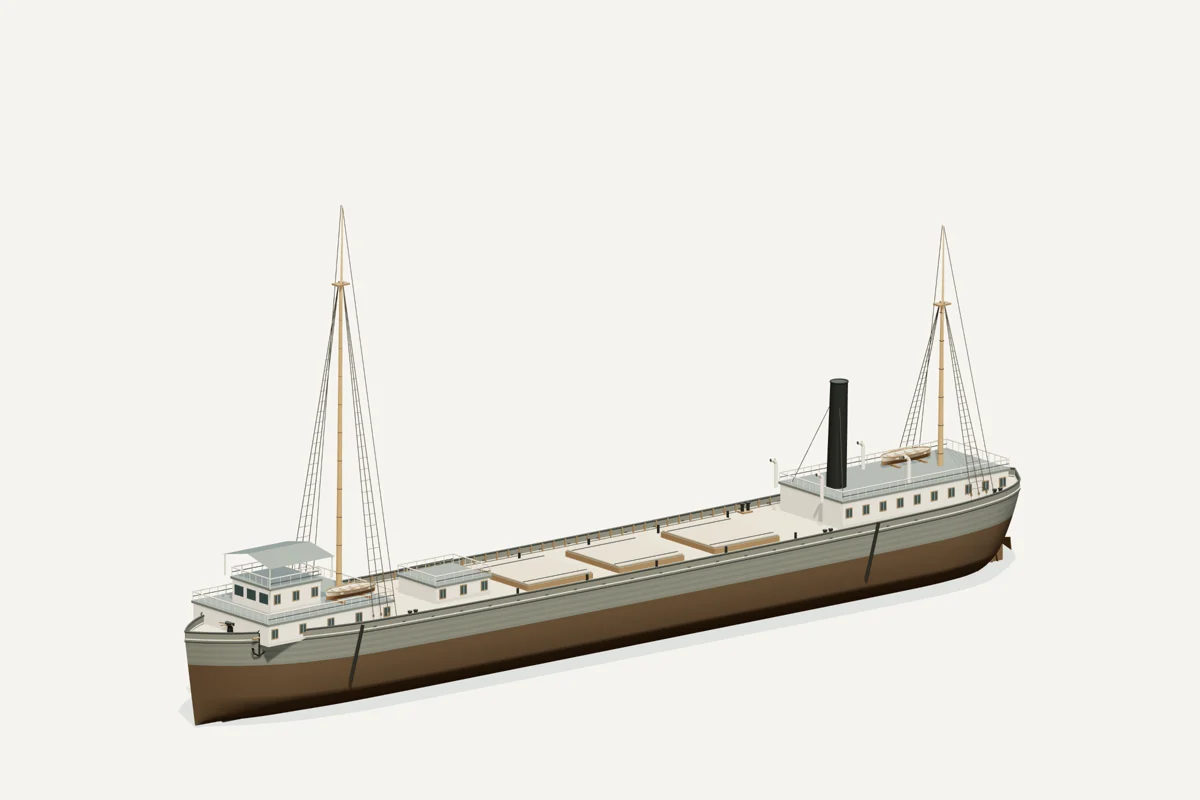
Starboard bow · complete vessel · drag to rotate, scroll or pinch to zoom, right-drag to pan. Hiding a part shows what sat beneath it; it does not recreate the wreck.
What the model represents
From the model specification. Two lists, kept apart on purpose.
Documented
- Wooden freighter built by James Davidson in 1888, formerly George G.Hadley. NOAA vessel record
- NOAA catalogue dimensions 287×40 ft. NOAA vessel record
Inferred
- Underwater hull lines and draft
- Exact colors, fittings, hatch layout and rigging routes
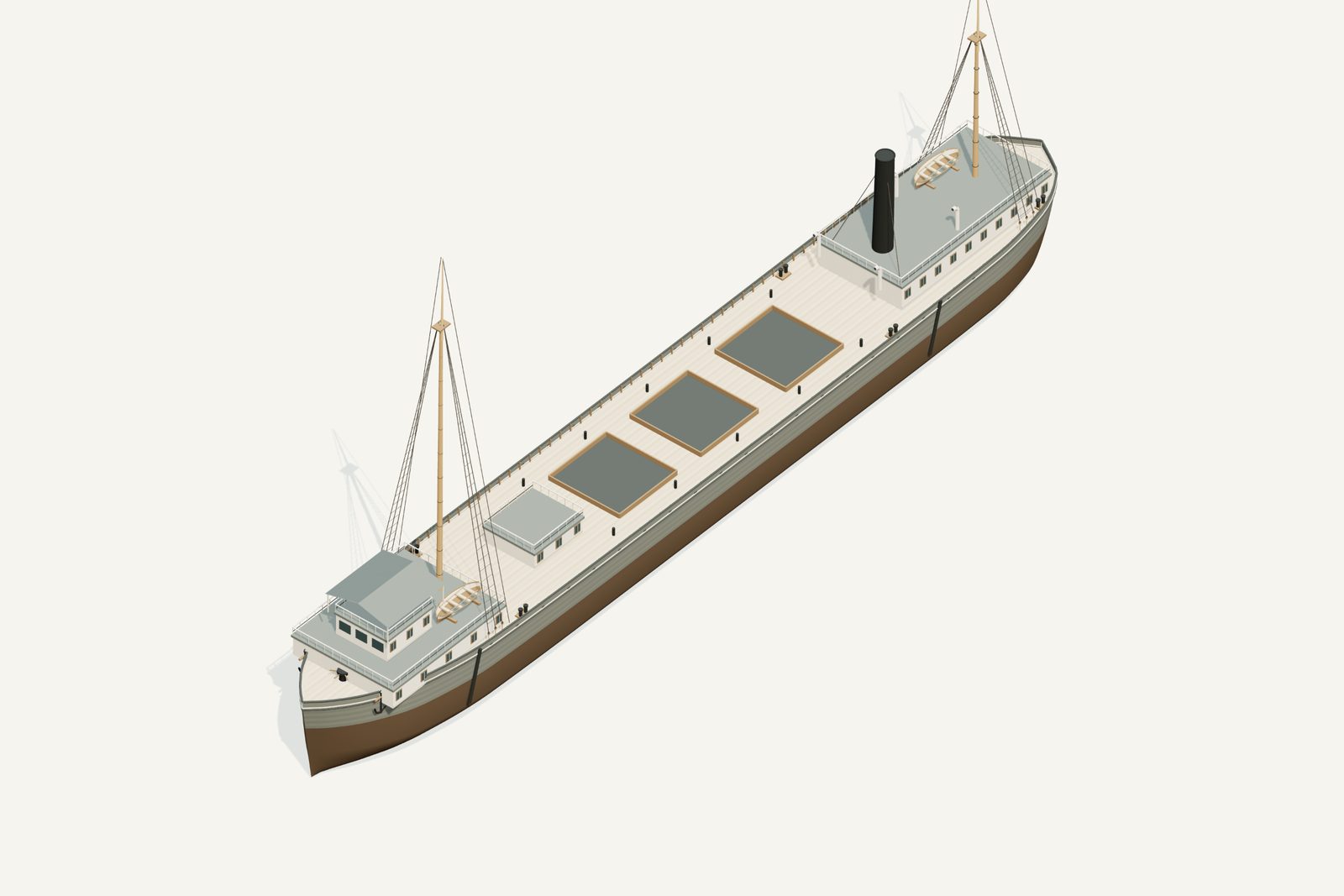
Configuration caveat. The inspected photograph guides the raised bow wheelhouse with canopy, two unequal masts, long cargo deck and single aft funnel. Exact hatch count, hidden hull lines, fittings and colors are interpreted; the photo date and final-voyage configuration are unverified.
Two numbers that are not the same thing. The waterline toggle sits at 5.20 m above the keel, a display assumption, not a measured draft. The wreck lies in about 17 ft of water; that describes the site, not the ship.
Renders from the model
History, evidence and limits
The research notes behind the reconstruction, reproduced with their citations.
Version 1.1. Metadata and presentation revised September 8, 2026; original evidence review retained.
Selected appearance
Photographed William P. Rend career form. The inspected photograph guides the raised bow wheelhouse with canopy, two unequal masts, long cargo deck and single aft funnel. Exact hatch count, hidden hull lines, fittings and colors are interpreted; the photo date and final-voyage configuration are unverified.
Documented evidence
Wooden freighter built by James Davidson in 1888, formerly George G.Hadley. NOAA vessel record
NOAA catalogue dimensions 287×40 ft. NOAA vessel record
Reasonable interpretation
Underwater hull lines and draft
Exact colors, fittings, hatch layout and rigging routes
Keep visible alongside the model. The inspected photograph guides the raised bow wheelhouse with canopy, two unequal masts, long cargo deck and single aft funnel. Exact hatch count, hidden hull lines, fittings and colors are interpreted; the photo date and final-voyage configuration are unverified.
Sources and use.
Unresolved uncertainties
No complete original lines plan is claimed. Exact loaded draft, concealed surfaces and fine fittings remain interpreted. The earlier research context below retains the source distinctions used for this reconstruction.
Evidence assessment: build a qualified interpretation. Documentary scale and vessel class, inspected visual sources or close period comparisons support a reasonable overall likeness. This is not an exact or authenticated as-built replica.
Documented baseline and conflicts. NOAA identifies the wooden James Davidson-built 1888 freighter, formerly George G. Hadley, and gives 287 × 40 ft. The tracker rounds length to 288 ft; model scale follows NOAA without editing catalogue values. The inspected photograph labeled William P. Rend shows the long open cargo well, raised forward wheelhouse and open canopy, two unequal masts and one large funnel at the aft machinery house. Its exact date is unknown, so this is a photographed career form, not an asserted loss-day state.
Comparison-based features and unresolved details. Relative placement and large visible forms follow the photograph, including its conspicuous forward canopy. Exact scale of the upper works, number and spacing of cargo hatches, deck vents, ship boats, glazing, hull strengthening details, paint and invisible underwater body are approximations. Three cargo hatches are selected for the exposed deck between houses; this is not a documented hold count. NOAA’s discussion of internal diagonal iron reinforcement does not justify displaying a fictitious lattice across the outside of the hull. The modeled external braces are simplified photographic features.
Sources

Illustration conditions
Illustration setting. Supplemental AI artwork uses a lake background. Weather, waves, light and distant shoreline are artistic scene choices, not evidence of the final voyage or an exact geolocated coastline. Storm and rain scenes never establish historical weather. Direct model renders retain consistent neutral presentation.
Sources used for the model
- NOAA vessel record — source
Identity, scale, career and surviving remains - Historical William P. Rend photograph — source
Inspected directly: raised forward house and open canopy, tall foremast, shorter aft mast, aft single funnel and long cargo deck. Photograph is a visual source, not an exact scale drawing.
Rights and respect
Removing or disturbing wreckage on Great Lakes bottomlands is a felony under Michigan Part 761, 1994 PA 451, at a fair market value of $100 or more. Positions are historical reference only — not navigation and not dive-planning data. Wreck records are published by the Michigan Underwater Preserve Council.
Treat these as graves. Lives were lost on many Great Lakes wrecks and human remains may still be present. Look, photograph, and leave everything exactly as you found it.
Model and renders were newly made for this project (2026). Three.js r160.1 is used under the MIT licence; its notice ships with the vendored files. Wreck position, depth and dates: Michigan Underwater Preserve Council. The model specification (version 1.1, revised 2026-09-08) is published beside the assets (model-spec.json).