Uarda
Later passenger-excursion form, after service as a private steam yacht
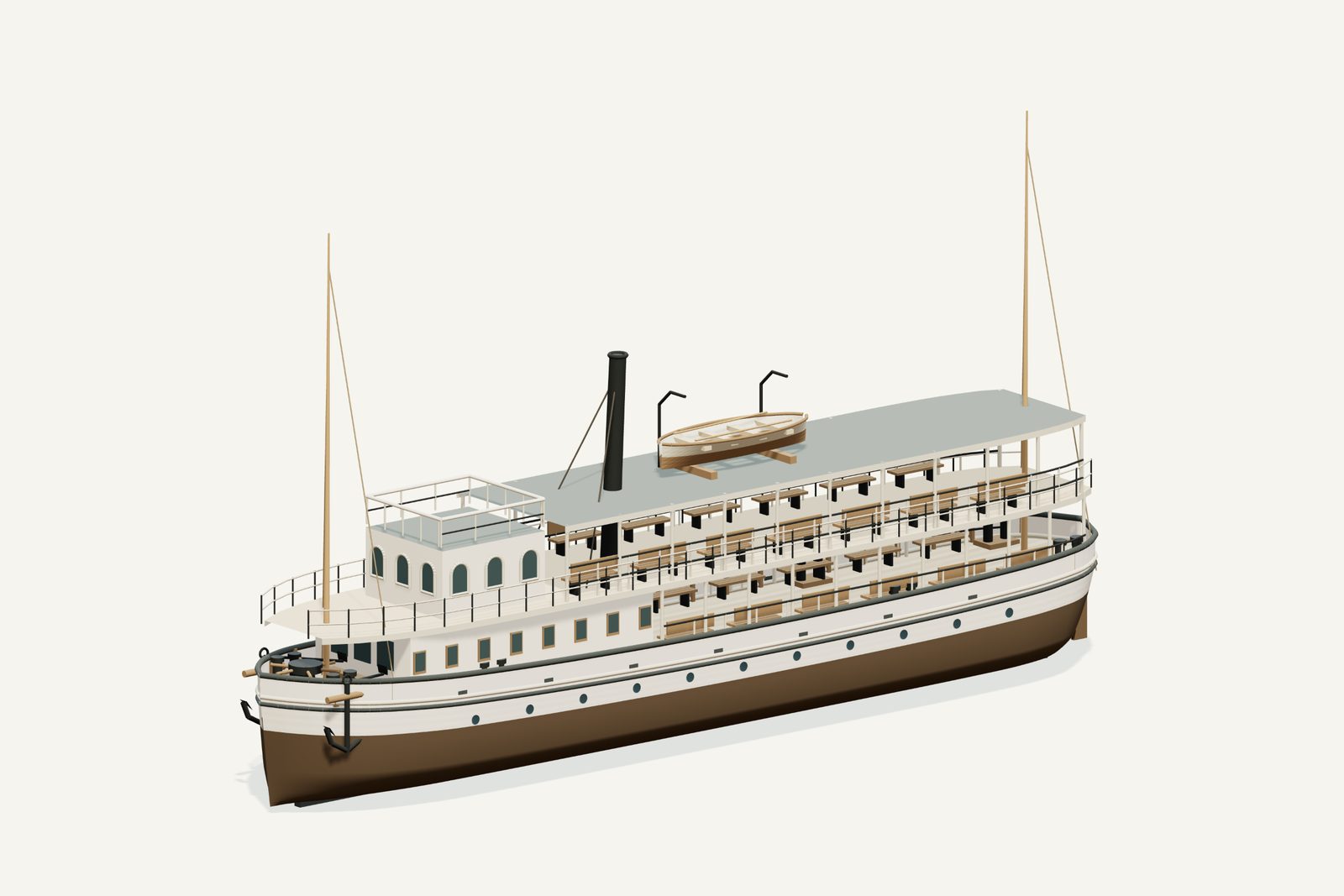
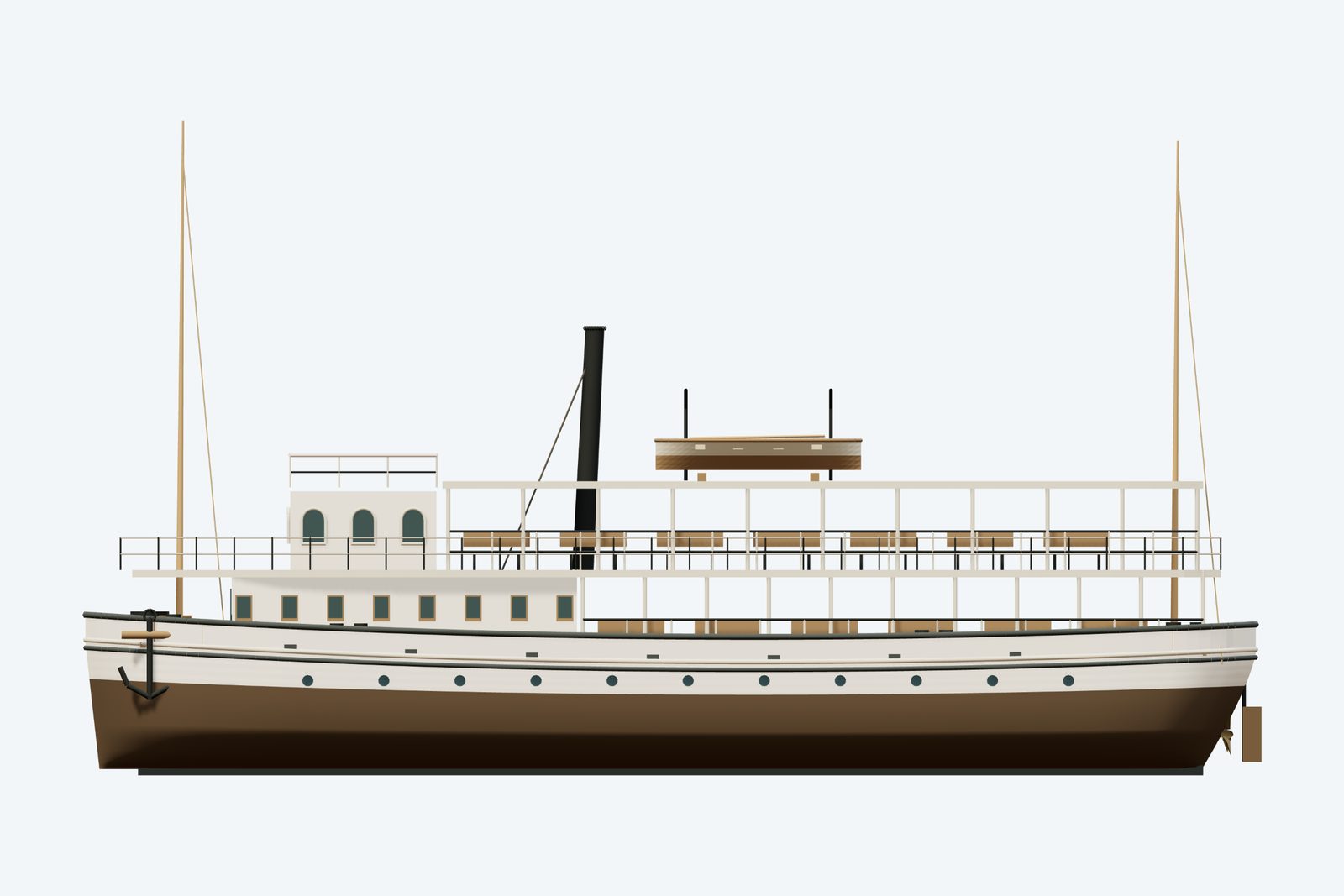
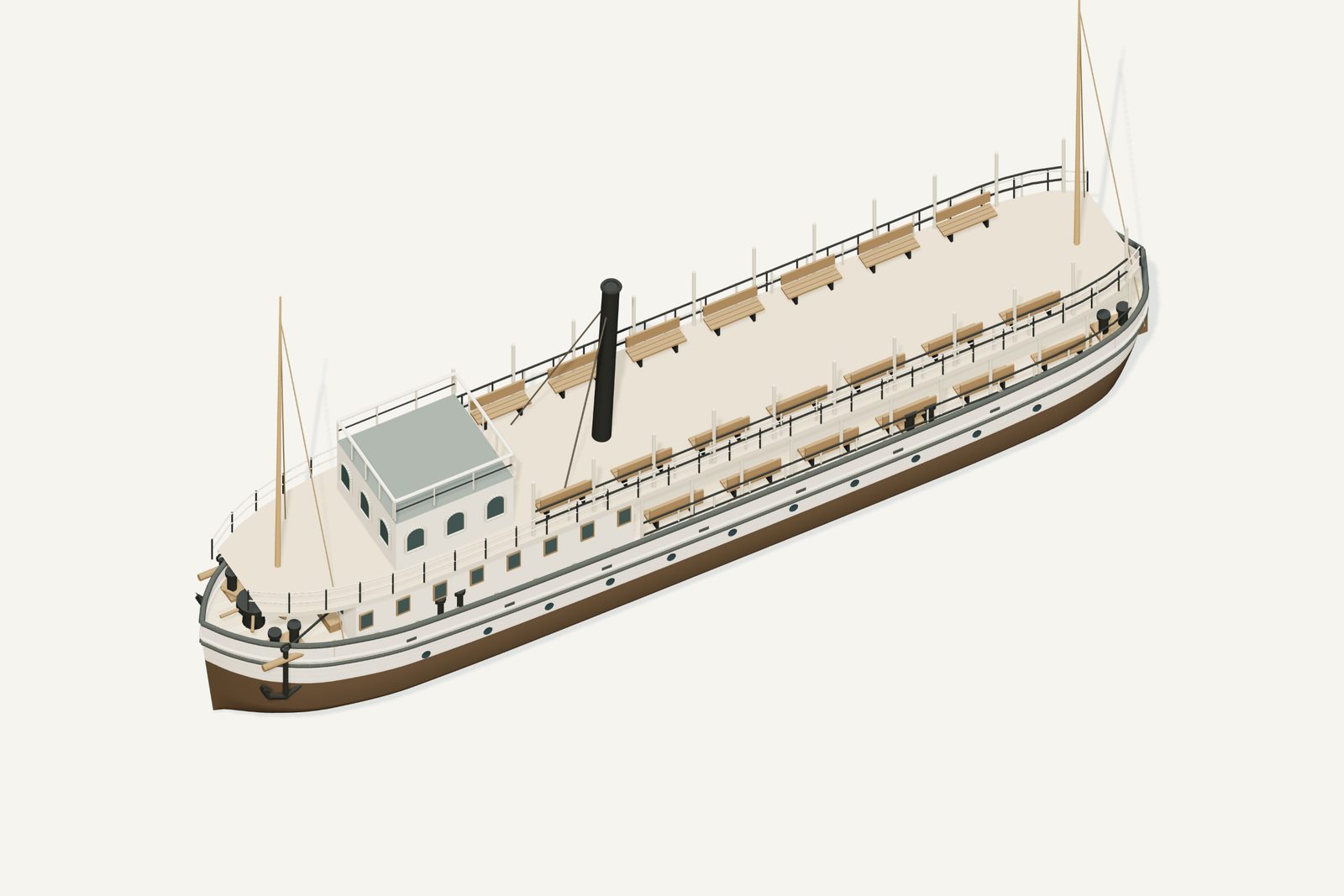
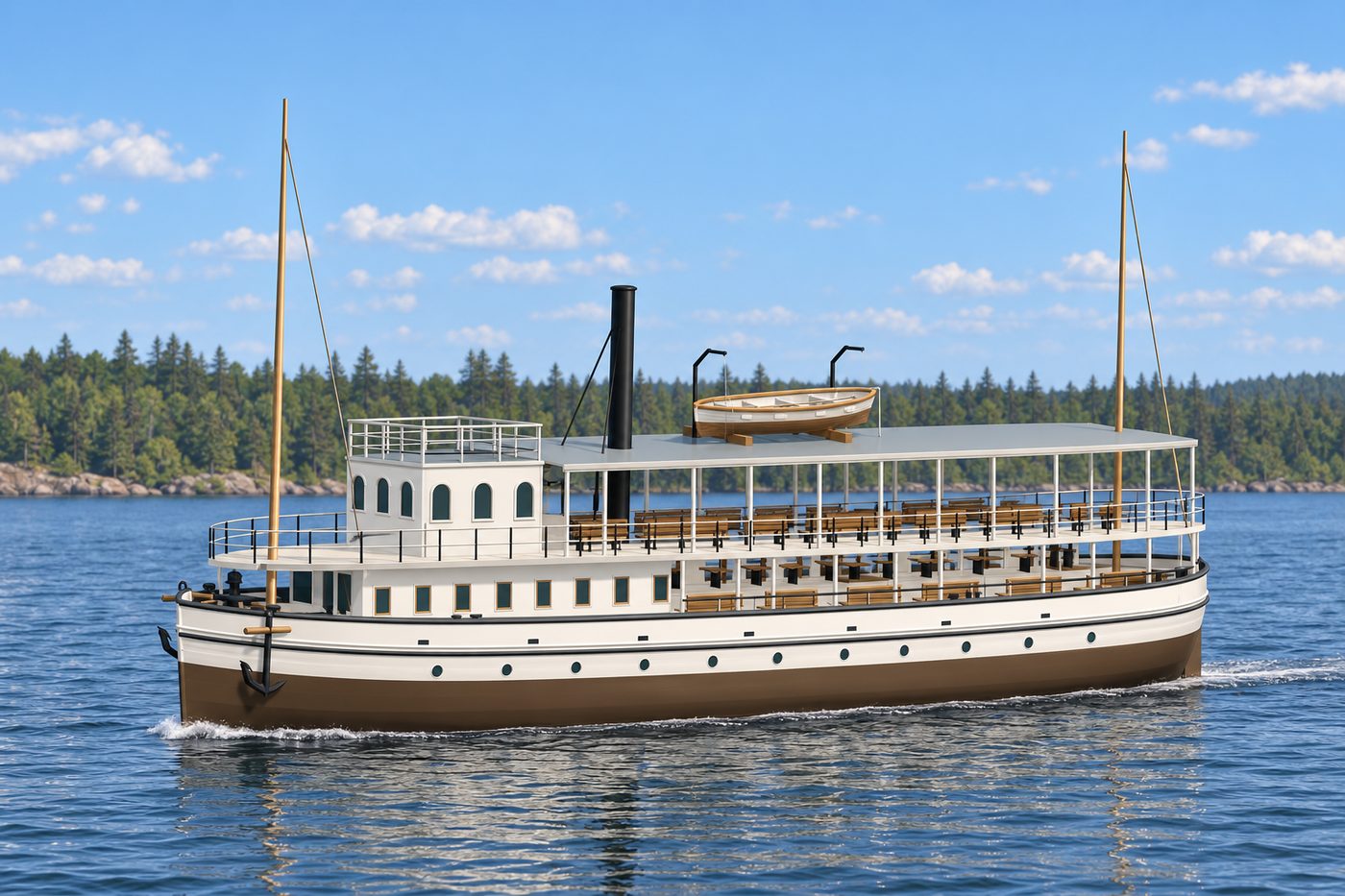
An interpretive 3D reconstruction of the vessel afloat, in the form named above and from before its loss in Keweenaw Bay. It is informed by the historical record set out under History below, where the documented evidence and the interpretation are kept apart; rigging, colours and fittings are partly inferred. It is not a survey of the wreck.
Nobody knows the exact spot where this ship went down, so the marker shows the general area.
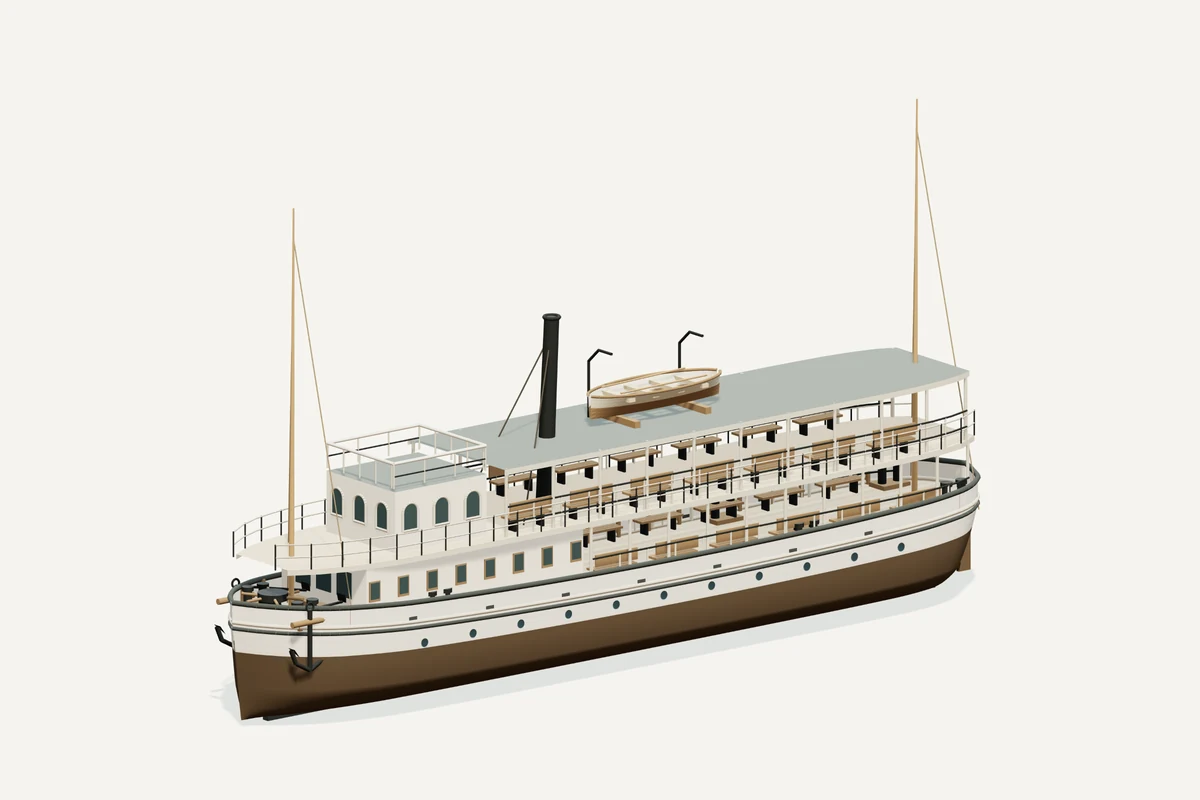
Starboard bow · complete vessel · drag to rotate, scroll or pinch to zoom, right-drag to pan. Hiding a part shows what sat beneath it; it does not recreate the wreck.
What the model represents
From the model specification. Two lists, kept apart on purpose.
Documented
- The David Bell yard table lists an iron screw schooner built at Buffalo in 1881, hull 26, US 25243, 95.3 × 17.5 × 8.3 ft registered dimensions and 110 ft overall; its original owner was Cameron D. Waterman. David Bell register.
- The two historical photographs show an enclosed forward main-deck cabin and open after main deck, an upper canopy on light stanchions, a boat carried above it, arched forward-house windows, an open railed bridge, one tall narrow funnel and two thin pole masts. The accompanying history describes the original steam yacht and later excursion service. Baillod, Uarda.
- Uarda burned at Seager’s wood dock in Ripley on June 4, 1912. Captain Werner suspected arson; it is not established as a finding. The remains sank in the Portage Canal by April 1913. Baillod.
Inferred
- Canopy extent and stanchion spacing estimated from photographs; benches, hidden windows, davits and boat fittings interpreted.
- Paint pigments, plate boundaries, underwater hull and loaded waterline are not recovered measurements.
Configuration caveat. Later excursion form, not the private yacht as built. Own photographs guide the open after main deck, upper canopy, arched forward house, boat, tall funnel and two pole masts. The 17.5 ft register beam conflicts with Baillod’s 12.5 ft; concealed hull and fitting details remain interpreted.
Two numbers that are not the same thing. The waterline toggle sits at 1.90 m above the keel, a display assumption, not a measured draft. The wreck lies in about 20 ft of water; that describes the site, not the ship.
Renders from the model
History, evidence and limits
The research notes behind the reconstruction, reproduced with their citations.
Version 1.1. Revised September 8, 2026.
Selected appearance
Later passenger-excursion form, after service as a private steam yacht. Two open passenger levels, an upper canopy and a tall funnel follow the vessel’s own photographs. This is not the private yacht as built.
Documented evidence
The David Bell yard table lists an iron screw schooner built at Buffalo in 1881, hull 26, US 25243, 95.3 × 17.5 × 8.3 ft registered dimensions and 110 ft overall; its original owner was Cameron D. Waterman. David Bell register.
The two historical photographs show an enclosed forward main-deck cabin and open after main deck, an upper canopy on light stanchions, a boat carried above it, arched forward-house windows, an open railed bridge, one tall narrow funnel and two thin pole masts. The accompanying history describes the original steam yacht and later excursion service. Baillod, Uarda.
Uarda burned at Seager’s wood dock in Ripley on June 4, 1912. Captain Werner suspected arson; it is not established as a finding. The remains sank in the Portage Canal by April 1913. Baillod.
Reasonable interpretation
Canopy extent and stanchion spacing estimated from photographs; benches, hidden windows, davits and boat fittings interpreted.
Paint pigments, plate boundaries, underwater hull and loaded waterline are not recovered measurements.
Unresolved uncertainties
Baillod gives 12.5 ft beam, conflicting with the selected 17.5 ft shipyard-register value. The stated 110 ft overall and 95.3 ft registered lengths are explicitly distinguished by the register.
The 93 figure in the former tracker length was gross tonnage, not feet. The boat and canopy toggles are inspection aids.
Sources
Illustration conditions
Supplemental AI artwork is made from the revised model render where the model changed; the provenance records the actual input files. Lake, shore, sky and weather are artistic staging, not evidence of a final voyage or a measured location. The actual GLB and its direct renders are the geometry reference.
Rights and respect
Removing or disturbing wreckage on Great Lakes bottomlands is a felony under Michigan Part 761, 1994 PA 451, at a fair market value of $100 or more. Positions are historical reference only — not navigation and not dive-planning data. Wreck records are published by the Michigan Underwater Preserve Council.
Treat these as graves. Lives were lost on many Great Lakes wrecks and human remains may still be present. Look, photograph, and leave everything exactly as you found it.
Model and renders were newly made for this project (2026). Three.js r160.1 is used under the MIT licence; its notice ships with the vendored files. Wreck position, depth and dates: Michigan Underwater Preserve Council. The model specification (version 1.1, revised 2026-09-08) is published beside the assets (model-spec.json).