O.E. Parks
Comparative pulpwood-carrier form, before 1929
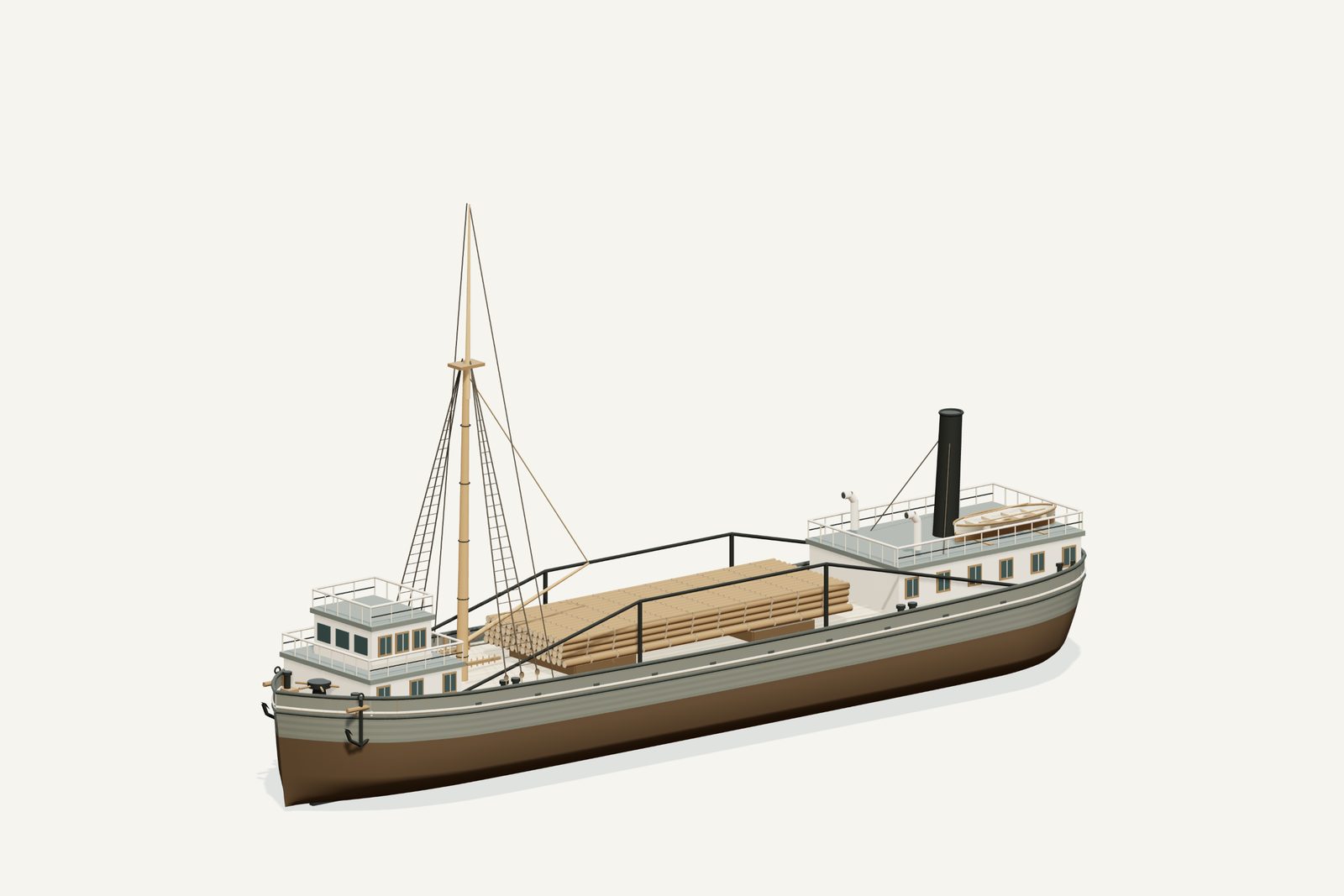
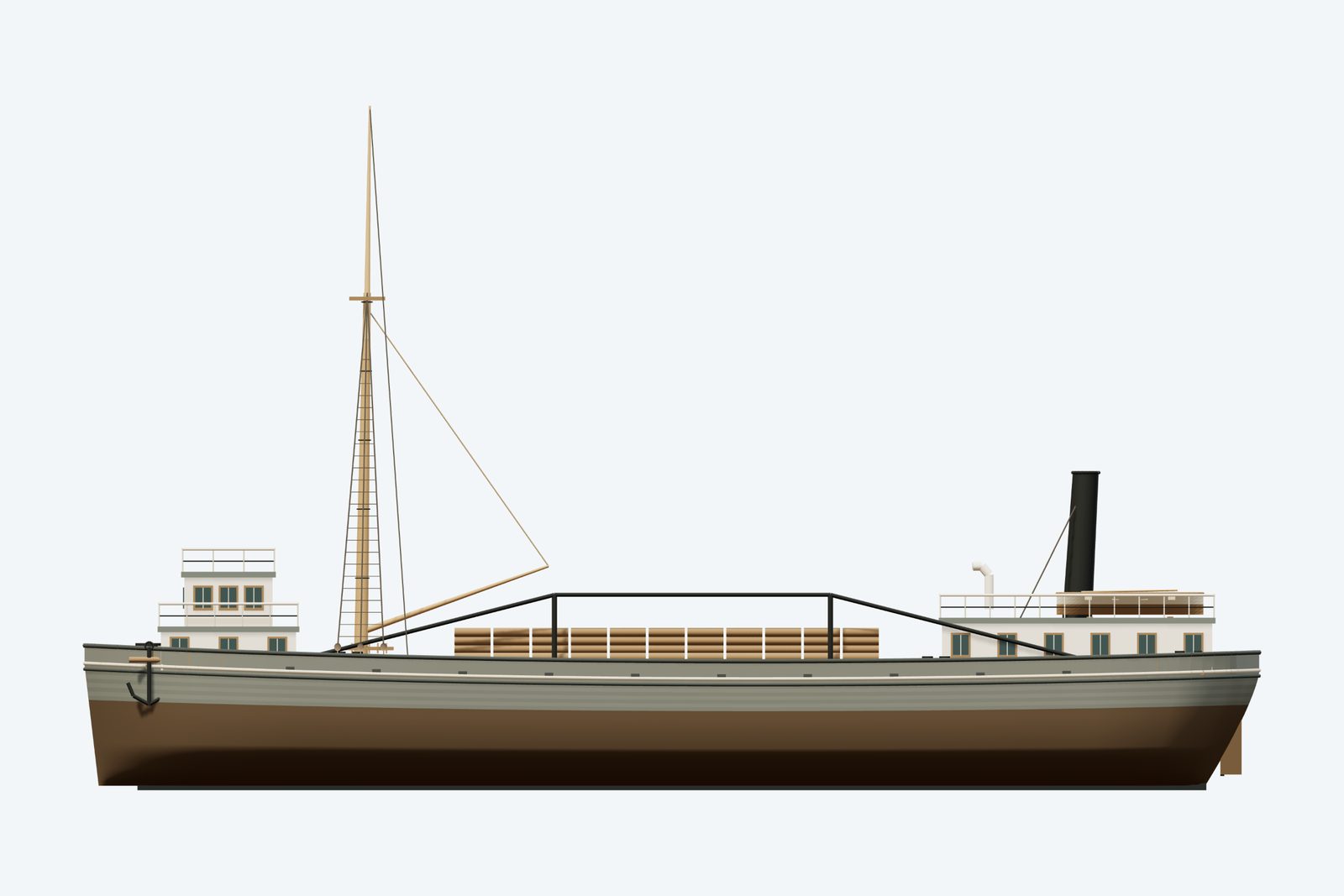
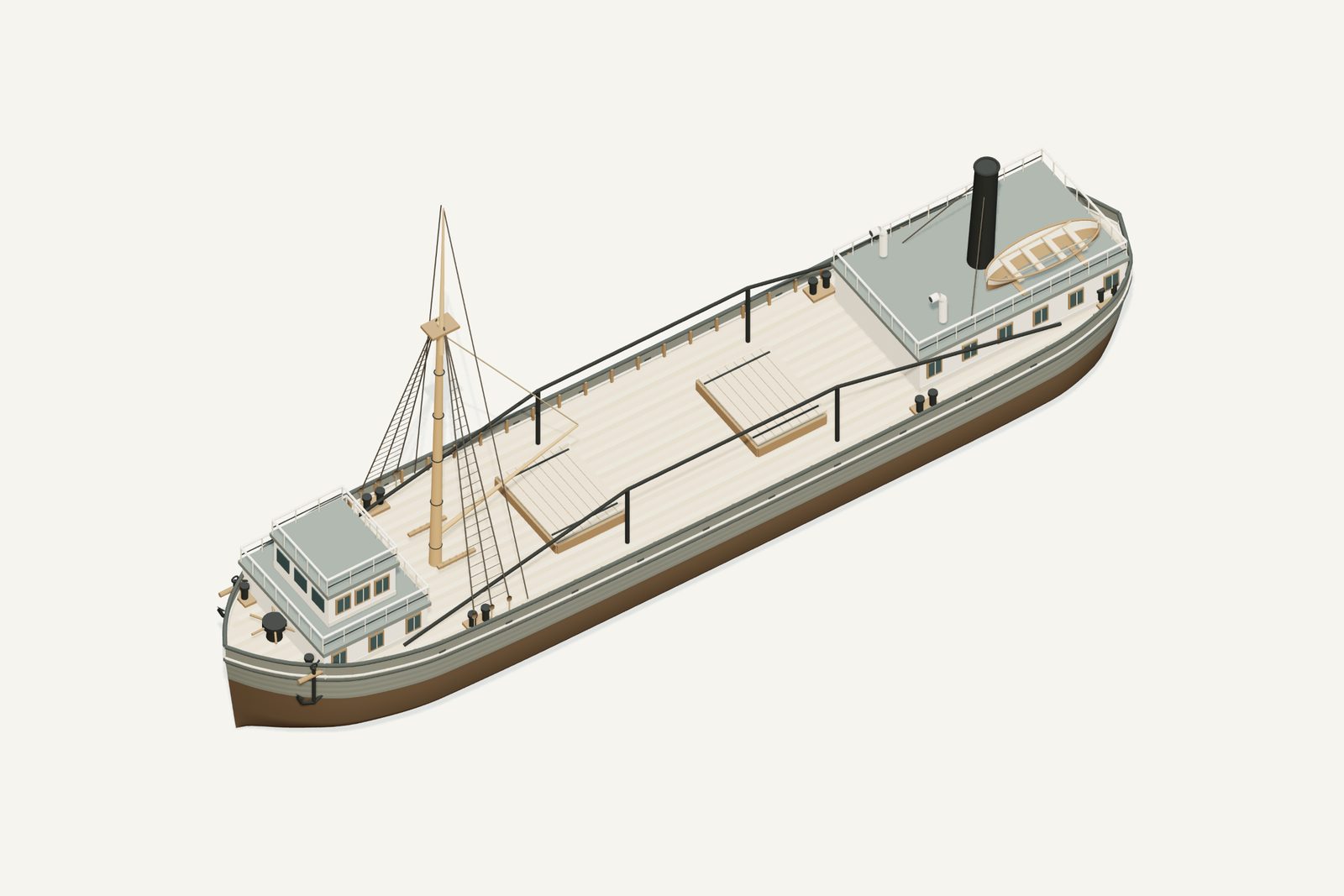
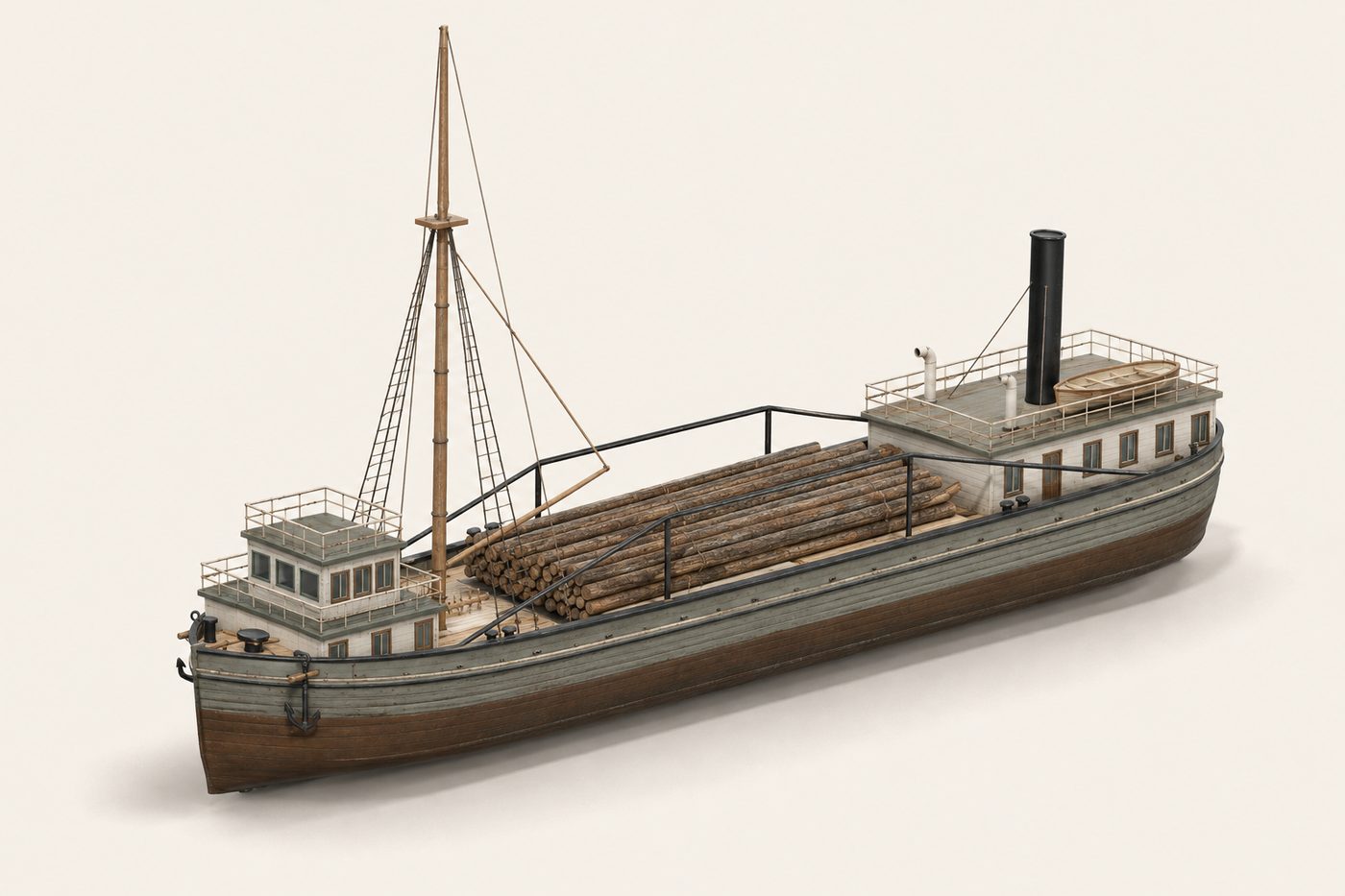
An interpretive 3D reconstruction of the vessel afloat, in the form named above and from before its loss in Thunder Bay. It is informed by the historical record set out under History below, where the documented evidence and the interpretation are kept apart; rigging, colours and fittings are partly inferred. It is not a survey of the wreck.
Nobody knows the exact spot where this ship went down, so the marker shows the general area.
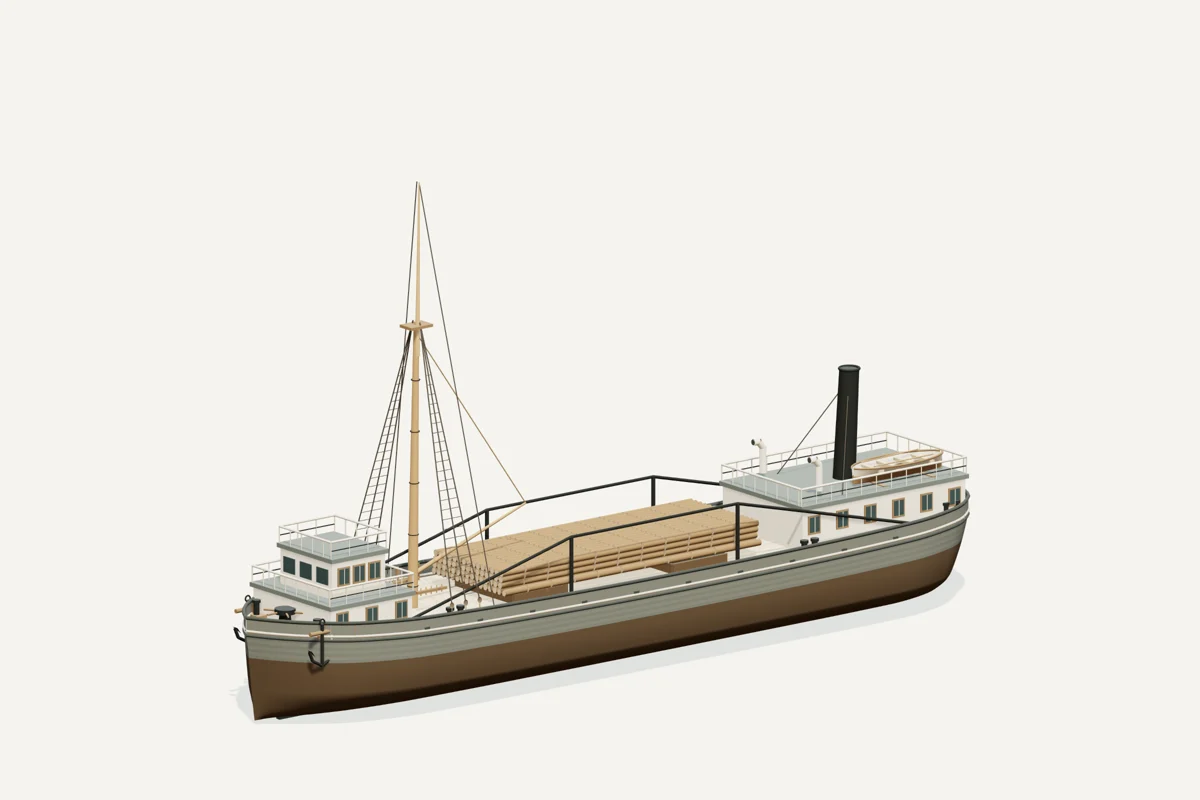
Starboard bow · complete vessel · drag to rotate, scroll or pinch to zoom, right-drag to pan. Hiding a part shows what sat beneath it; it does not recreate the wreck.
What the model represents
From the model specification. Two lists, kept apart on purpose.
Documented
- NOAA records an 1891 steam barge with dimensions 134×28 ft. NOAA vessel record
- The wreck includes a shaft log, rider keelsons and a large metal hogging truss. NOAA vessel record
Inferred
- Underwater hull lines and draft
- Exact colors, fittings, hatch layout and rigging routes
Configuration caveat. NOAA records the scale, shaft log, pulpwood trade and metal hogging truss. The forward bridge, aft funnel, single cargo mast and deck arrangement are comparisons with period steam barges, not a recovered portrait; the exact working silhouette remains qualified.
Two numbers that are not the same thing. The waterline toggle sits at 2.65 m above the keel, a display assumption, not a measured draft. The wreck lies in about 62 ft of water; that describes the site, not the ship.
Renders from the model
History, evidence and limits
The research notes behind the reconstruction, reproduced with their citations.
Version 1.1. Metadata and presentation revised September 8, 2026; original evidence review retained.
Selected appearance
Comparative pulpwood-carrier form, before 1929. NOAA records the scale, shaft log, pulpwood trade and metal hogging truss. The forward bridge, aft funnel, single cargo mast and deck arrangement are comparisons with period steam barges, not a recovered portrait; the exact working silhouette remains qualified.
Documented evidence
NOAA records an 1891 steam barge with dimensions 134×28 ft. NOAA vessel record
The wreck includes a shaft log, rider keelsons and a large metal hogging truss. NOAA vessel record
Reasonable interpretation
Underwater hull lines and draft
Exact colors, fittings, hatch layout and rigging routes
Visual evidence and comparisons. No complete ship-specific historical portrait was recovered from the accessible sources. Monohansett’s historical images and the ECU study provide a nearby wooden steam-barge comparison for separate forward navigation and aft machinery spaces. The documented hull type, scale, cargo and metal truss constrain the overall form; this is a comparative likeness.
Visible qualification. NOAA records the scale, shaft log, pulpwood trade and metal hogging truss. The forward bridge, aft funnel, single cargo mast and deck arrangement are comparisons with period steam barges, not a recovered portrait; the exact working silhouette remains qualified.
Sources and use.
Unresolved uncertainties
No complete original lines plan is claimed. Exact loaded draft, concealed surfaces and fine fittings remain interpreted. The earlier research context below retains the source distinctions used for this reconstruction.
Evidence assessment: build a qualified interpretation. The evidence and comparisons below support a credible overall likeness. This is not an exact or authenticated as-built replica.
Documented baseline and source differences. NOAA identifies the 1891 steam barge, 134 × 28 ft, sunk in 1929 carrying pulpwood. The wreck includes a shaft log, rider keelsons and a large metal hogging truss. Probable fuel tanks are reported with appropriately tentative identification.
Reasonable interpretations and unresolved details. A single cargo mast, aft funnel, compact forward bridge, short pulpwood deck stacks and a metal tension-truss arrangement are selected interpretations, not recovered positions. The displayed load uses simplified cylindrical billets rather than a measured pulpwood stowage plan. Exact rig, funnel profile, deckhouse form, paint and submerged hull remain visibly qualified. The possible tanks are not exposed on deck as a certainty.
Sources

Illustration conditions
Lake, shoreline, lighting and weather are artistic staging, not evidence of a specific historical voyage. AI artwork is supplemental; the GLB and direct renders establish the delivered geometry.
Sources used for the model
- NOAA vessel record — source
Identity, dimensions, history and surviving evidence - ECU Monohansett archaeological report — source
Read historical text, printed pp. 30–35: dimensions, changing rig and funnel count, and fore/aft deckhouse arrangement. PDF image rendering/download was unavailable; photographs were separately inspected on Commons. - Historical Monohansett photograph — source
Inspected two masts, twin funnels, forward wheelhouse and aft machinery house. This is an earlier career form, not the reduced late coal-carrier form.
Rights and respect
Removing or disturbing wreckage on Great Lakes bottomlands is a felony under Michigan Part 761, 1994 PA 451, at a fair market value of $100 or more. Positions are historical reference only — not navigation and not dive-planning data. Wreck records are published by the Michigan Underwater Preserve Council.
Treat these as graves. Lives were lost on many Great Lakes wrecks and human remains may still be present. Look, photograph, and leave everything exactly as you found it.
Model and renders were newly made for this project (2026). Three.js r160.1 is used under the MIT licence; its notice ships with the vendored files. Wreck position, depth and dates: Michigan Underwater Preserve Council. The model specification (version 1.1, revised 2026-09-08) is published beside the assets (model-spec.json).