Benjamin Franklin
Early side-wheel steamer, c.1842–1850
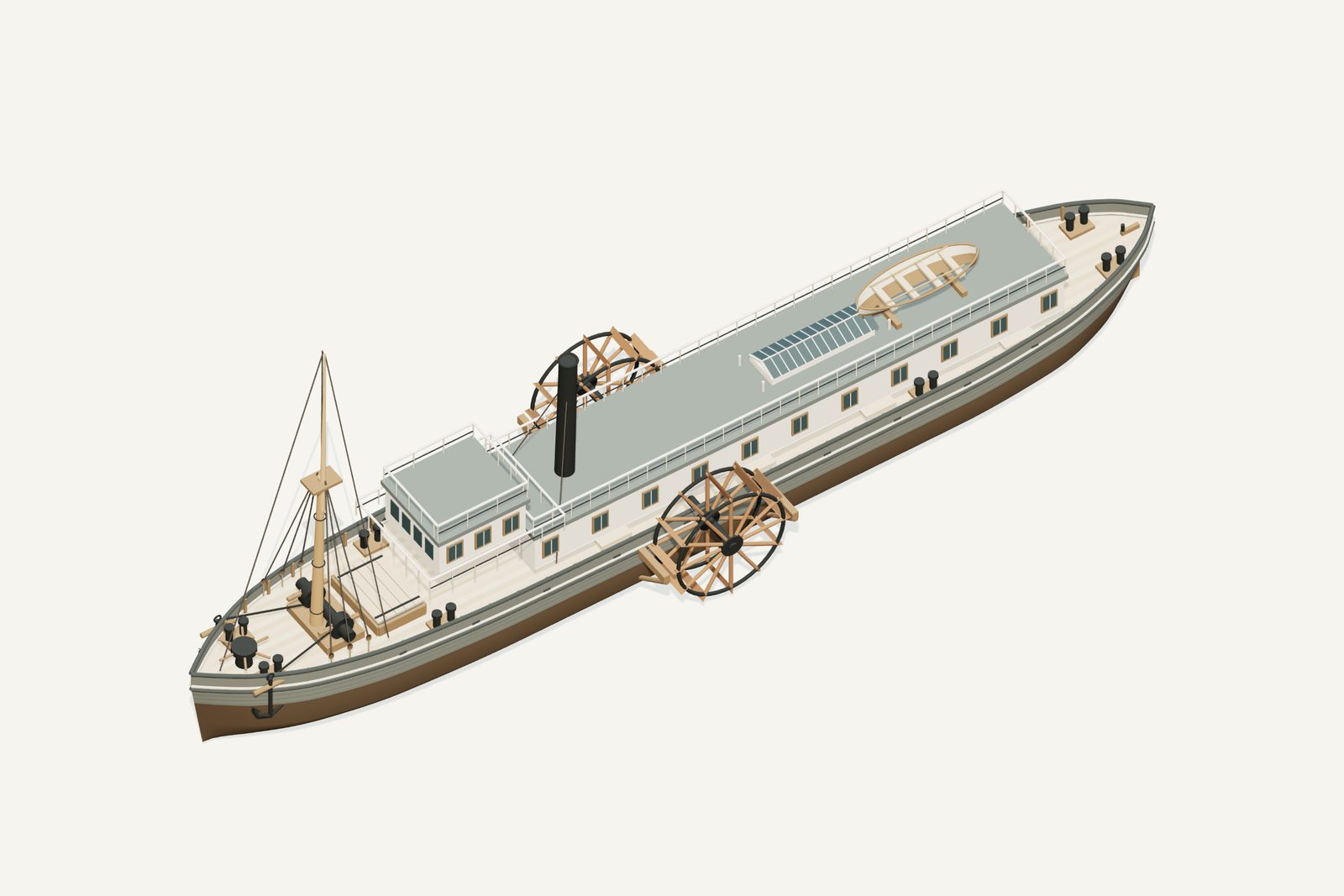
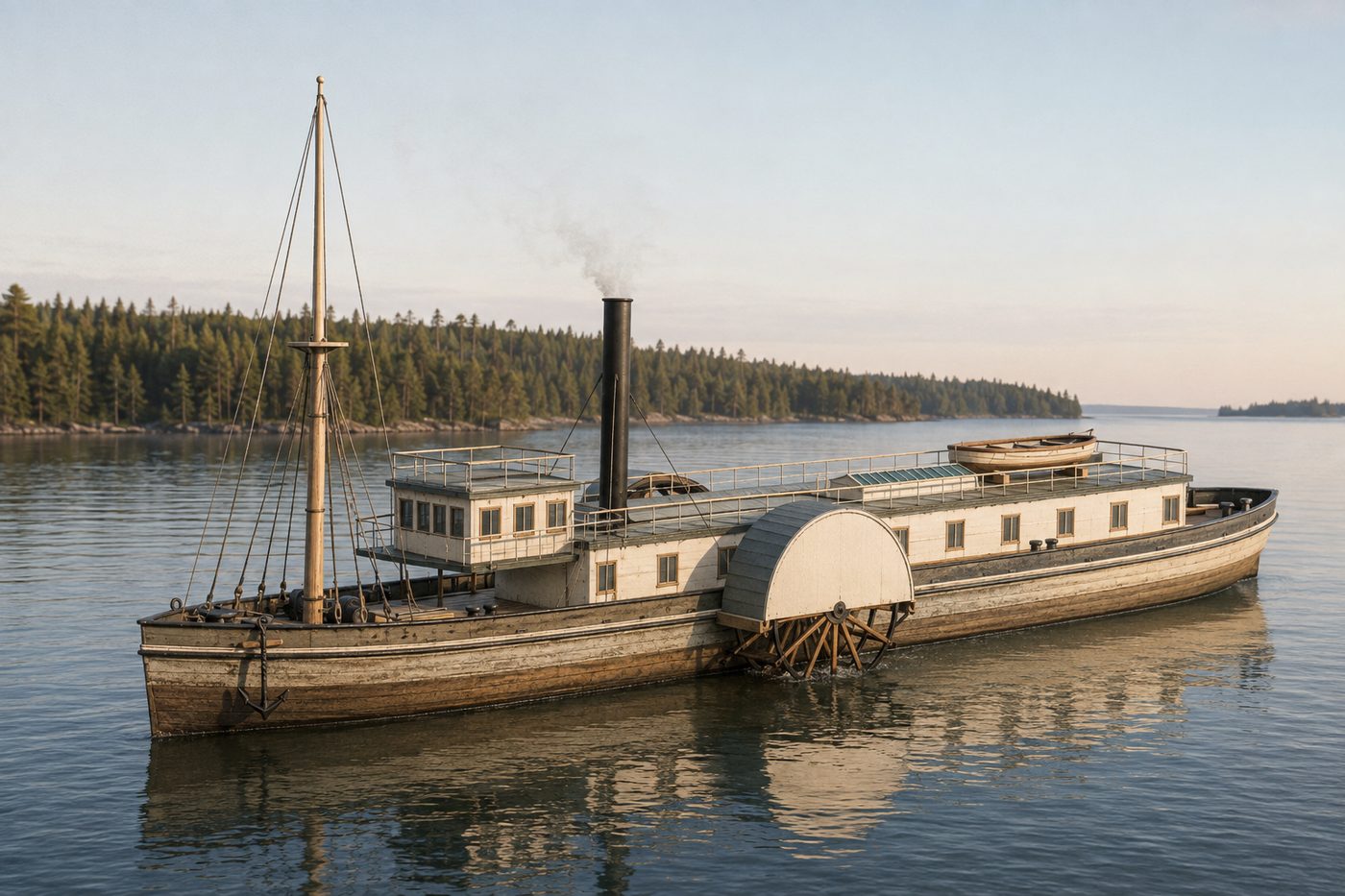
An interpretive 3D reconstruction of the vessel afloat, in the form named above and from before its loss in Thunder Bay. It is informed by the historical record set out under History below, where the documented evidence and the interpretation are kept apart; rigging, colours and fittings are partly inferred. It is not a survey of the wreck.
This ship ran aground along this shore. Nobody knows the exact spot, so the marker shows the general area.
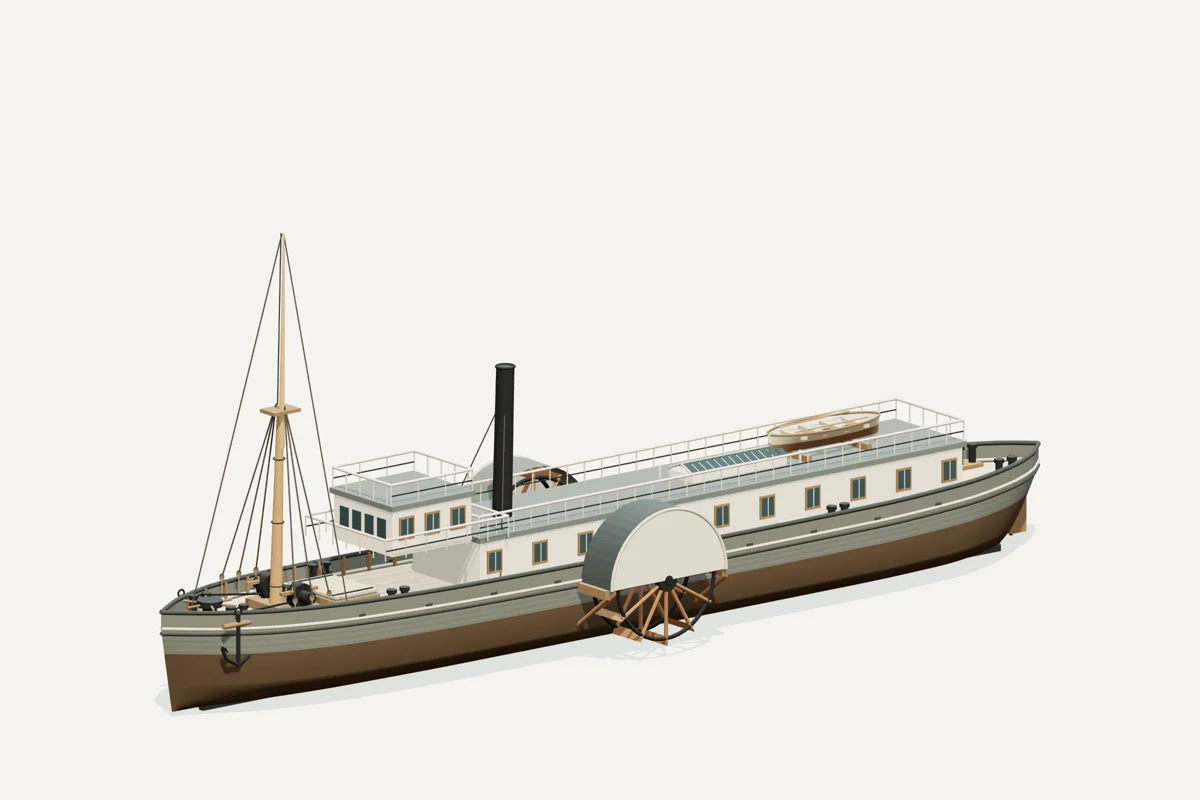
Starboard bow · complete vessel · drag to rotate, scroll or pinch to zoom, right-drag to pan. Hiding a part shows what sat beneath it; it does not recreate the wreck.
What the model represents
From the model specification. Two lists, kept apart on purpose.
Documented
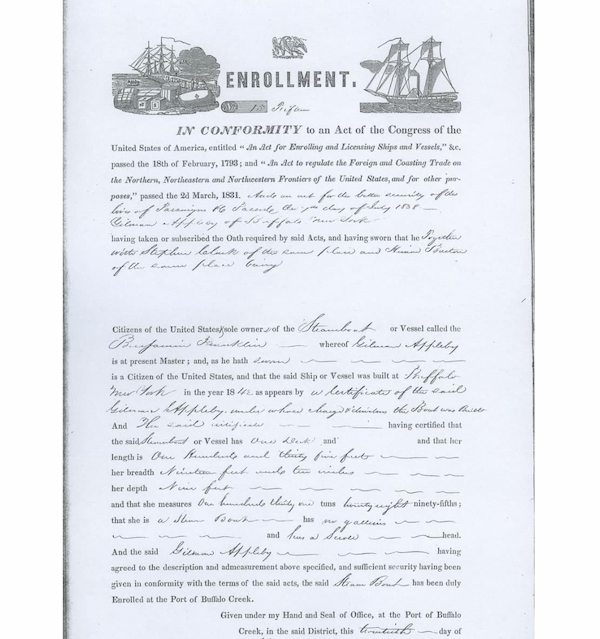
- Enrollment dimensions 135 ft×19 ft 10 in×9 ft. Enrollment scan via NOAA / Great Lakes Maritime Collection
- The enrollment identifies one deck. Enrollment scan via NOAA / Great Lakes Maritime Collection
Inferred
- Underwater hull lines and draft
- Exact colors, fittings, hatch layout and rigging routes
Configuration caveat. Enrollment-based hull baseline: 135 ft long, 19 ft 10 in wide and 9 ft hold depth. Paddle wheels extend beyond hull beam. Surviving shafts establish side-wheel propulsion, but no intact hull or original arrangement drawing was recovered. Cabin, funnel, wheel diameter and one bare working mast are provisional.
Two numbers that are not the same thing. The waterline toggle sits at 2.05 m above the keel, a display assumption, not a measured draft. The wreck lies in about 15 ft of water; that describes the site, not the ship.
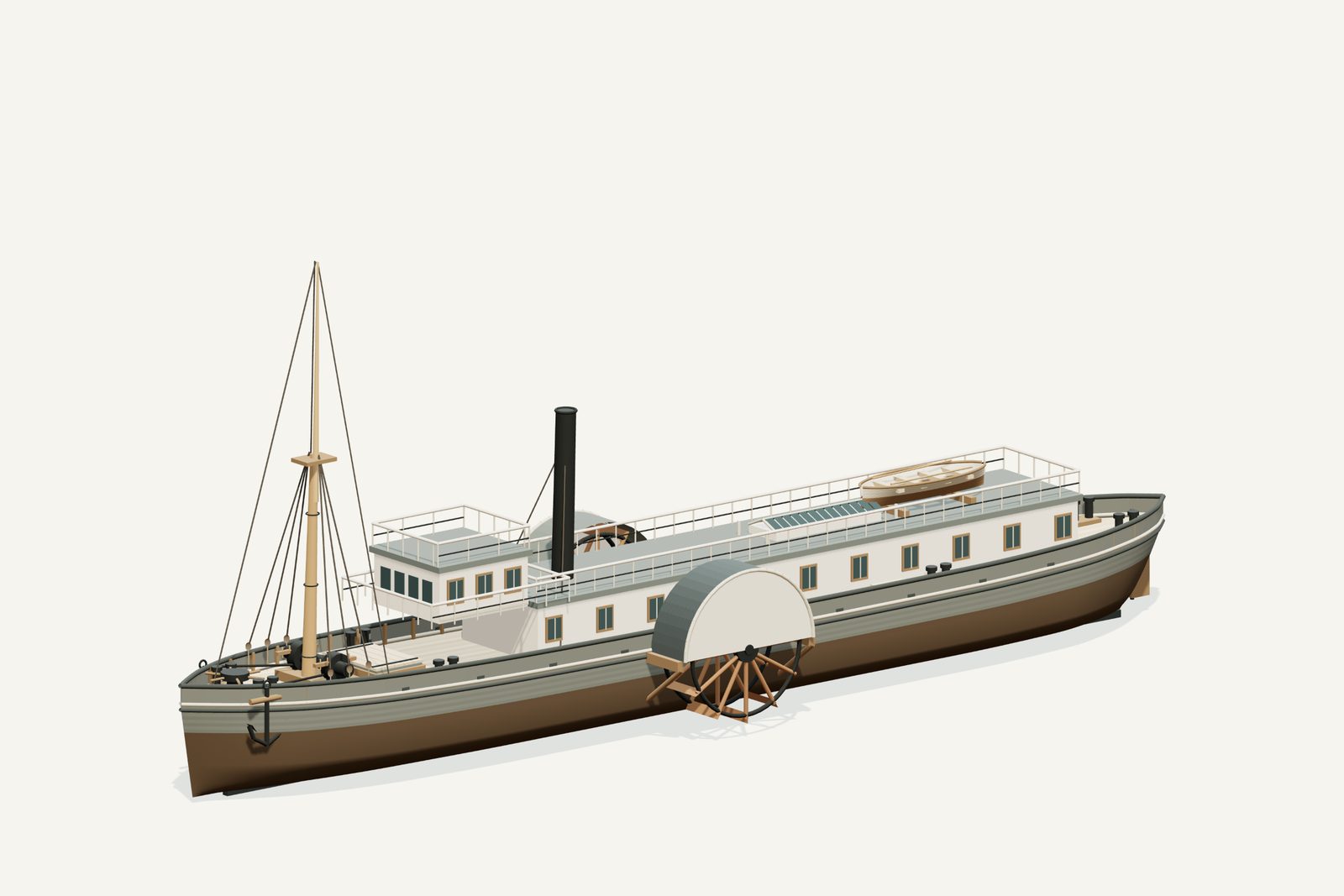
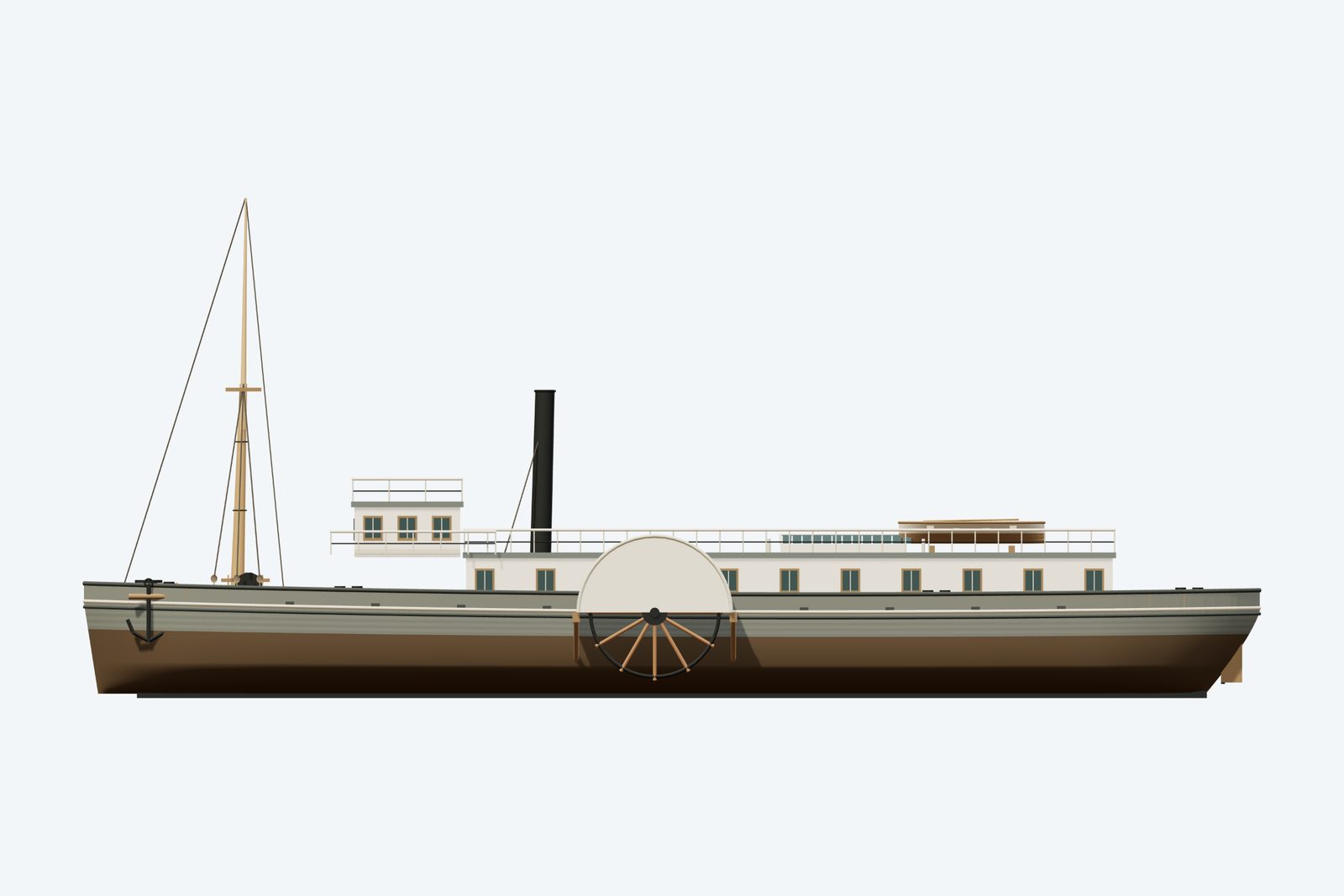
Renders from the model
History, evidence and limits
The research notes behind the reconstruction, reproduced with their citations.
Version 1.1. Metadata and presentation revised September 8, 2026; original evidence review retained.
Selected appearance
Early side-wheel steamer, c.1842–1850. Enrollment-based hull baseline: 135 ft long, 19 ft 10 in wide and 9 ft hold depth. Paddle wheels extend beyond hull beam. Surviving shafts establish side-wheel propulsion, but no intact hull or original arrangement drawing was recovered. Cabin, funnel, wheel diameter and one bare working mast are provisional.
Documented evidence
Enrollment dimensions 135 ft×19 ft 10 in×9 ft. Enrollment scan via NOAA / Great Lakes Maritime Collection
The enrollment identifies one deck. Enrollment scan via NOAA / Great Lakes Maritime Collection
Reasonable interpretation
Underwater hull lines and draft
Exact colors, fittings, hatch layout and rigging routes
The reconstruction represents the small wooden side-wheel steamer built in 1842 and lost in 1850. NOAA identifies builder Gilman Applebee at Buffalo and describes surviving wheel shafts, hubs and cylindrical boilers, with no located hull sections. NOAA vessel record.
The enrollment image linked by NOAA reads 135 ft length, nineteen feet and ten inches breadth, and nine feet depth. It identifies a one-deck vessel. The model uses that transcription: 41.148 m length, 6.0452 m hull beam and 2.7432 m hold-depth baseline. NOAA's short web summary rounds the beam to 19 ft. The handwritten document, rather than the rounded web beam, sets model scale. Enrollment scan, Great Lakes Maritime Collection via NOAA. The decorative vessel images printed at the top of the enrollment are generic document ornament and were not used as portraits of this ship.
Side-wheel propulsion is documented; the above-water appearance remains largely inferred. Each model wheel has wooden spokes and twelve fixed floats around iron hoops. A removable upper paddle box exposes the wheels. A roughly 0.9 m hub diameter follows the source's approximate three-foot hub description, but 5 m wheel diameter, float count, width, shaft elevation and sponson structure are chosen engineering visualization dimensions. NOAA notes unequal surviving shaft forms after a replacement; the display uses symmetric wheels and does not reconstruct that repair exactly.
No intact photograph, original hull lines, machinery arrangement or cabin plan was recovered. A modest single cabin, forward steering house, one central funnel, one bare forward working mast, skylight, lifeboat, seating and anchors are provisional period details. The model does not claim a verified walking-beam or other engine mechanism, and no internal engine is shown. The hull has no screw propeller or stern paddle wheel. The extra width across paddle boxes is intentional; the enrollment beam refers to the hull, not the extremity of the wheels.
setPaddleboxes(boolean) controls paddle_boxes. Removing these upper covers leaves the shafts, spokes, rims, floats and supporting sponsons visible. There are no display sails. The waterline at Y=2.05 m and deck at Y=2.95 m are illustrative; the documented hold depth is not a draft measurement. The selected intact working form is an evidence-informed type reconstruction, not a fully documented likeness.
Unresolved uncertainties
No complete original lines plan is claimed. Exact loaded draft, concealed surfaces and fine fittings remain interpreted. The earlier research context below retains the source distinctions used for this reconstruction.
Sources
Illustration conditions
Lake, shoreline, lighting and weather are artistic staging, not evidence of a specific historical voyage. AI artwork is supplemental; the GLB and direct renders establish the delivered geometry.
Sources used for the model
Rights and respect
Removing or disturbing wreckage on Great Lakes bottomlands is a felony under Michigan Part 761, 1994 PA 451, at a fair market value of $100 or more. Positions are historical reference only — not navigation and not dive-planning data. Wreck records are published by the Michigan Underwater Preserve Council.
Treat these as graves. Lives were lost on many Great Lakes wrecks and human remains may still be present. Look, photograph, and leave everything exactly as you found it.
Model and renders were newly made for this project (2026). Three.js r160.1 is used under the MIT licence; its notice ships with the vendored files. Wreck position, depth and dates: Michigan Underwater Preserve Council. The model specification (version 1.1, revised 2026-09-08) is published beside the assets (model-spec.json).