Fish
Sea Lamprey
Petromyzon marinus

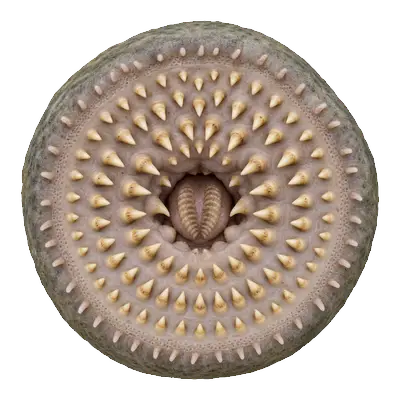
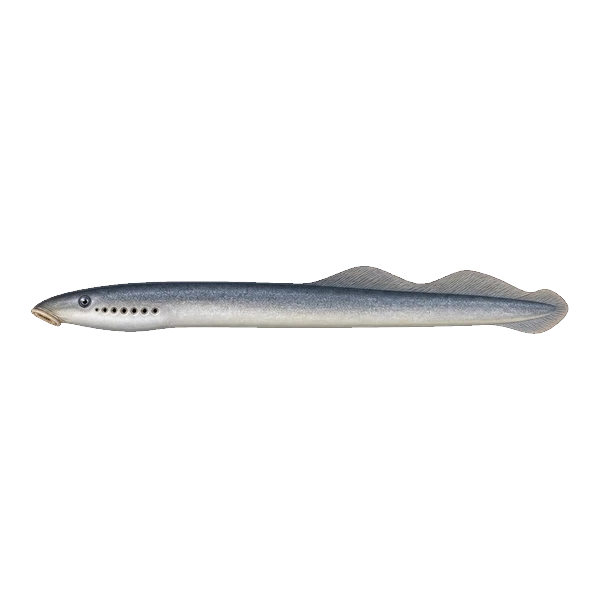
These illustrations are AI-generated, not photographs, and are not to scale. They show what to look for; they are not a substitute for an expert identification.
How to identify it
Size: Adults commonly about 2 feet long.
- An eel-like body with no scales and no paired fins.
- A round, jawless sucking mouth ringed with rows of small, sharp teeth.
- Seven small gill openings in a row behind each eye.
- Two separate fins along the back.
Don’t confuse it with
Michigan's native lampreys include the silver and chestnut lampreys, which have one continuous notched fin along the back instead of two separate fins. The American eel has jaws and fins behind its head.
Sea lamprey live mainly in the Great Lakes and the rivers that flow into them. It does not attack people.
Where it came from
Native to the Atlantic Ocean.
Reached the upper Great Lakes through shipping canals that bypass Niagara Falls.
Earliest dated Michigan record: 1936, Lake Michigan. This is the oldest dated record in the USGS non-native species database, not necessarily when it first arrived.
Why it matters
It feeds by attaching to large fish such as lake trout and feeding on their blood and body fluids, which often kills them. By the 1950s it had helped collapse lake trout populations in the upper Great Lakes. Today it is controlled by a joint United States and Canada program.
Michigan law
Not on Michigan's list of prohibited or restricted species. Sea lamprey are controlled across the Great Lakes by the Great Lakes Fishery Commission, working with United States and Canadian agencies. The state’s page on this species.
If you find it
- Don’t move it. Michigan law requires boaters to remove all aquatic plants from boats, equipment and trailers before launching. Before trailering, you must pull all drain plugs, drain live wells and bilges, and make sure the boat and trailer are free of aquatic plants and animals. What the law requires
- Never release bait. Releasing baitfish into Michigan waters is illegal. Put unused bait in the trash, never in the water.
- Report it. Take a photo, note where you saw it, and report it to the Midwest Invasive Species Information Network (MISIN) or through Michigan’s invasive species program. Experts there can confirm what you found.
- Ask before removing or treating. Treating a lake with herbicides or other chemicals needs a state permit, and some removal work does too. Start with the state’s Aquatic Nuisance Control program before taking action.
Michigan lakes where it has been recorded
2 Michigan lakes on this site have a record of this species.
Alger
Charlevoix
A lake that is not listed may still have it. Records exist only where someone found the species and reported it, so “not recorded” does not mean “not present.”
Lake records: Midwest Glacial Lakes Partnership Conservation Planner; underlying records from the USGS Nonindigenous Aquatic Species database.
Sources
Earliest dated record: USGS Nonindigenous Aquatic Species database.